The father’s boat came to the Vestbø landing at the dusk of the third day.
Olav and Peder unloaded the catch at the landing in the last of the light—the sea bass and the blue fish and the red fish in the kegs, the cod and the deep-sea grayfish, the salmon and the trout, the lobsters in the basket at the stern—and they carried it up the path to the house. The deep-sea lines and the five witch-nets they left coiled and folded at the bottom of the boat, because the lines and the nets were Bjørn Olsen Lindøy’s, loaned for the fishing, and would go back to Lindøy. Jens came down to the landing at the dusk. He looked at the catch at the kegs and the basket and said it was a good catch, and the three of them carried the catch up to the house.
The supper at the kitchen at Vestbø was the three of them at the table.
Jens at the head of the table, and Peder at the side, and Olav at the place at the east side that had been set for him since the homecoming of the summer before. The aunt had left a pot at the stove and gone back across the hill before the boat came in. The supper was the fish of the trip and the bread, and the three of them ate it at the kitchen at the evening of the homecoming, and the talk at the table was the talk of the catch and the Vignesholmene grounds and the work the farm had had while the brothers had been at the islands.
The cough was at the table.
It had come back at the second night at Vignesholmene, and it had not gone off, and it was at Olav’s chest at the kitchen at Vestbø, and Olav coughed it at the table twice in the course of the meal. Peder did not look up at the coughing of it. Peder had been at the other side of the camp-fire at the island when the cough came back, and he had set the driftwood at the fire and not said the thing, and at the kitchen table at Vestbø Peder did the kitchen-table form of the not-saying, which was the not-looking-up from his plate. Jens was at the head of the table. Jens had heard the cough in the house since the first week of May, when Olav had come home from the school, the way a man heard the things that were in his house; and Jens heard it again at the supper of the homecoming and did not say the thing either. He set down his cup. He asked Peder a question about the upper-field fence-rail. Peder answered it. The supper went on, and the cough was at the table, and the three of them were at the not-naming of it the way the two brothers had been at the not-naming of it at the fire at Vignesholmene.
Olav told his father at the upper field.
He told him at the second haying, on a forenoon of the days after the homecoming. The second crop was a thin crop the way the second crop was thin at the upper field every year, and Jens and Olav were at the mowing of it with the scythes, and Peder was at the byre. Olav came to the end of a swath and stopped. He stood with the scythe and said the thing he had decided at the back room at the nights since the islands.
“I will go to Helland,” Olav said. “I will hire onto a ship.”
Jens stood at the end of his own swath. He looked at the bay below the field, where the forenoon light was on the water, and he did not look at his son, because a thing of that kind was said better between two men who were both at the looking at the bay.
“Yes,” Jens said.
He did not say more than that. He did not say that the boy had a navigator’s certificate at the chest at the back room and could wait for a navigator’s berth and not take the first berth Helland had at the lists. He did not say that the boy had a cough at his chest and that a cough was a thing a man carried to a doctor and not to sea. He did not ask which ship, or what wage, or for how long. He said yes, and the yes was the whole of what Jens had to say at the upper field about his son going back to the sea, and the two of them went on with the mowing of the thin second crop, and the matter of the hiring was decided at the field.
Olav took the lines and the witch-nets back to Lindøy on the Thursday.
He rowed the father’s boat across the strait with the deep-sea lines coiled and the five witch-nets folded at the forward thwart, and he came to the Lindøy boathouse at the noon. Bjørn was at the boathouse. Olav set the lines and the nets at the place at the boathouse Bjørn kept them in, and Bjørn looked at the witch-nets and said the nets had taken fish at Vignesholmene the way the nets took fish, and Olav said they had, and the matter of the loan was closed.
Olava came down the path to the boathouse.
She came down at the noon the way she had come down at the noon of the loading three weeks before. She stood at the door of the boathouse. She did not ask Olav what the fishing had been, because Bjørn had asked it and the answer had been said; and she did not ask him the other thing. She had been at the not-asking-state since the March. Olav stood at the boathouse and did not tell her that he had decided at the upper field to hire onto a ship, and he did not tell her that the cough had come back at the island, and Olava stood at the door and did not ask why he had the look of a man who had decided a thing and not said it. The two of them were at the strait-side at the noon at the not-saying. Then Olav said he would cross back to Vestbø at the tide, and Olava said the tide would serve him at the early afternoon, and Olav crossed back to Vestbø at the tide.
The chest was at the foot of the bed at the back room at Vestbø.
It was the chest that had come home from Goole, and the navigator’s certificate in the oilcloth was at the top of the chest where Olav had set it in the May. Olav stood at the back room at the morning before he crossed to Stavanger. He did not take the chest. He did not take the certificate. A man hiring onto a ship as a boatswain and a sailmaker did not carry a navigator’s certificate down to the wharf, and the chest at the foot of the bed at the back room would stand at the foot of the bed at the back room through the voyage; and Olav took the leather bag, and left the chest and the certificate at the back room, and crossed to Stavanger.
The office of Helland was at the wharf-end at Stavanger.
Olav had been at Helland’s office before. He had been at it in the July of 1876, when Helland had placed him on the Dronningen for the voyage that had gone to Archangel and the Atlantic and Jamaica, and he had been at it across the years of that voyage as the office that forwarded the letters; and the room at the wharf-end was a room Olav knew—the desk, the shipping-lists at the wall, the window that gave on the harbor.
Helland was at the desk.
A shipping-master at Stavanger in the year 1879 had a desk and a ledger and the lists of the ships that wanted hands, and Helland looked at Olav across the desk and knew him, because Helland had placed him before. Olav said he wanted a berth. Helland looked at the lists. He said there was the Brio, a schoonerbrig, loading salt at the wharf for the Russian fishermen at Vardøy and wanting a boatswain and a sailmaker. Olav said he had the navigator’s certificate now. Helland said the Brio was not wanting a navigator; the Brio was wanting a boatswain and a sailmaker; and that a man who had the navigator’s certificate could fill for the mate if the mate came to want filling for. Olav said he would take the berth.
Helland wrote the name at the articles.
He wrote Olav Hestby at the line for the boatswain and sailmaker, and Olav signed it under Helland’s writing, and the berth on the Brio was got. Helland set down the pen. He looked at Olav for a moment at the close of the writing—a moment longer than Helland had looked at him at the placing on the Dronningen—and Olav saw that Helland had a thing about the Brio that he was not saying, the way a shipping-master had things he did not say about the ships at his lists. Helland did not say the thing. He said the Brio would sail within the week, and that Olav was to be at the wharf for the loading, and he turned the ledger to the next matter.
The Brio was at the Stavanger wharf at the loading of the salt.
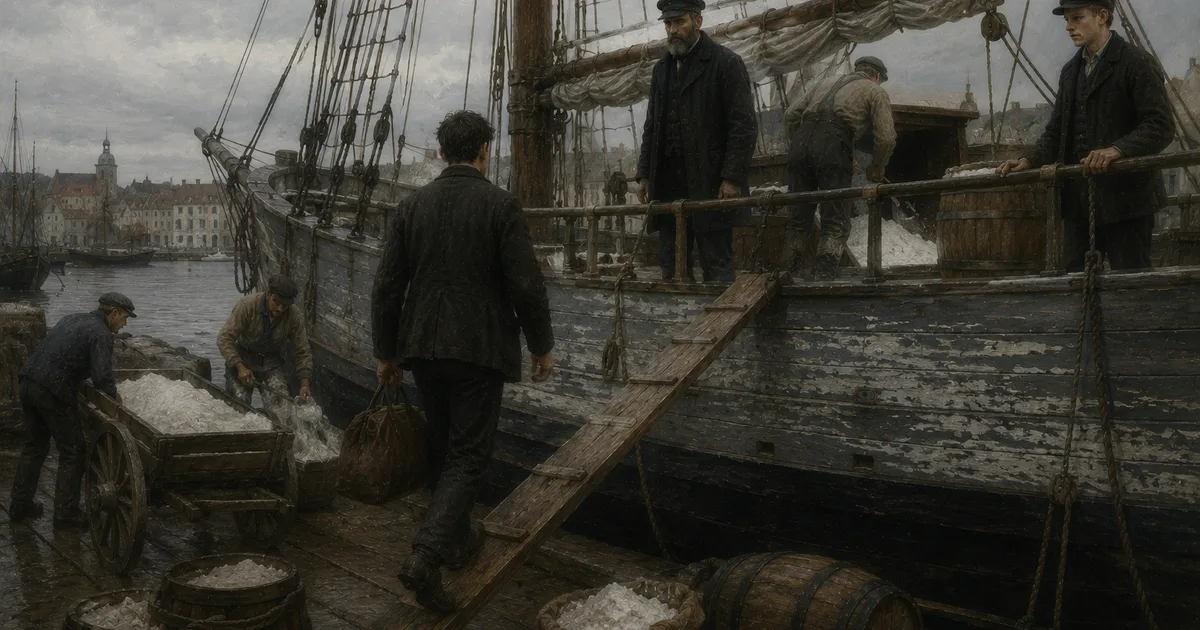
She was a schoonerbrig, not a new ship, her paint gone at the bulwarks to the gray that the salt-coast weather took paint to, and she was at the wharf with the salt going down into her holds for the Russian fishermen at Vardøy. The rigging of her was a clumsy rigging, set up in the way of a ship that had been a hard ship to work and would be a hard ship to work, and Olav saw it at the first looking-over a sailor gave a ship at the joining of her. He came aboard with the leather bag at his hand. He found the forecastle.
The forecastle of the Brio was under the main deck at the bow.
It was a low space and a dark space, and the bunks were at the two sides of it, and the floor of it was wet, and the air of it did not move, because there was no scuttle at the Brio’s forecastle to let the air move; and the air of it had the smell of the wet floor and the old bunks and the men who had been at the bunks before. Olav stood at the foot of the forecastle ladder with the leather bag at his hand and knew the kind of space it was. He had been at the kind of space before. He had been at it on the Asta under Captain Gjermund, and he had been at it on the American bark; the forecastle of the Brio was the third. The body of him at the foot of the ladder knew the smell and the dark and the no-air of it the way a body knew a thing it had been at before.
The captain of the Brio was a small man.
He was middle-aged, with a black full beard, and Olav saw him first at the deck at the loading. The captain looked at Olav and said little. He said Olav was the boatswain and the sailmaker, and Olav said he was, and the captain said the work of the boatswain and the sailmaker would be wanted from the wharf on, and he went back to the loading. The little the captain said was said in the way of a man who counted the words he said the way he counted the other things that cost him, and Olav, at the deck of the Brio at the loading, took the captain for the kind of master the Asta had had and the American bark had had, and not the kind the Dronningen had had.
It was at the wharf, at the loading, that Olav heard the Brio’s byname.
A man at the wharf—a wharf-hand, or a sailor off another ship, a man of the wharf in any case and not of the Brio—said it to another man at the loading-work, and Olav heard it the way a man at a wharf heard the talk of a wharf. The Brio had had a captain before this captain, a captain who had been a part-owner of her, and the coast had had a name for that captain; and the name the coast had had for him was Fa’en i Nordsjøan—the Devil of the North Sea. The man at the wharf said the name, and the other man said a thing back, and the two of them went on at the wharf-work. The captain who had carried the byname was not the captain of the Brio now. But the Brio was the ship that had carried the captain who had carried the byname, and the byname was at the wharf-talk around her at the loading, and Olav heard it and carried it down the forecastle ladder with him.
Abraham Hjelm was the first mate of the Brio.
Olav came to the name at the deck, when the captain named the mate in the naming-over of the ship’s people that a new hand got at the joining of a ship. The first mate is Abraham Hjelm. Olav heard the name. He had known of a Hjelm before—there had been a Hjelm at the Sigrid, the brig Olav had gone out on at his first voyage in the year 1875, a Paul Hjelm at the mate’s position of her—and Olav stood at the deck of the Brio and registered the surname, and the registering was a small thing at his interior and not a thing he said, because a man did not say to a first mate at the joining of a ship that he had known the man’s name on another ship. Abraham Hjelm was a straightforward man at the deck, a working mate at a tight-fisted ship and not a man at the captain’s tight fist with him, and Olav took the name and the man and went on at the joining.
Tobias Bjøravaag was at the Brio on his first voyage.
He was a youngman of Finnøy, and Olav knew the Bjøravaag name from the Hesby church. The Bjøravaags had a pew at Hesby, and Olav had sat at the Hestby pew at the third row at the Sundays of his life and had seen the Bjøravaag family at their pew across the years of the Sundays; and Olav saw Tobias Bjøravaag at the deck of the Brio and knew him for a Finnøy boy. Tobias was eighteen. He was at the Brio the way Olav had been at the Sigrid in the year 1875, which was the way of a Finnøy boy going out to sea for the first time, with the leather bag and the not-knowing-yet of what the forecastle of a ship was. Olav had been the boy at the deck at the first voyage. He saw the Bjøravaag boy at the deck of the Brio, and the boy did not yet know the forecastle he had come down the ladder into, and Olav did not tell him.
Olav laid the figure-eight at the cat-falls of the Brio.
He laid it at the forenoon of the day before the sailing, at the cat-falls at the bow, the way he had laid the figure-eight at the cat-falls of every ship he had been on since the Asta. The body of him laid it without being told to lay it. Abraham Hjelm was at the bow at the laying of it. Hjelm looked at the figure-eight at the cat-falls and did not say a thing at it, and Olav saw that the mate had seen it and had taken it for what it was, which was the work of a hand that knew the work. The captain was not at the bow. The captain did not see the figure-eight, and the seeing of it would not have changed the captain’s tight fist if he had seen it; and the figure-eight was the body’s, and the body laid it at the Brio’s cat-falls regardless of the captain.
The Brio sailed from Stavanger at the end of June.
She went out of the harbor at the morning tide with the salt in her holds for the Russian fishermen at Vardøy, and she stood north up the coast—the coast Olav had not been north of, the coast that ran up past the places a Stavanger sailor knew the names of and on past the places he did not, toward Lofoten and the North Cape and the Nordkyn and Vardøy at the top of the country. Olav was the boatswain and the sailmaker of her. Tobias Bjøravaag was the Finnøy boy at his first voyage. Abraham Hjelm was at the watch. The captain was at the cabin with his tight fist.
The cough was at the forecastle at the first night.
Olav was at the bunk at the first night out, at the forecastle under the main deck at the bow, at the wet floor and the no-air and the smell of it, and the cough came up at his chest in the dark. It was the cough of the February and the cough of the second night at Vignesholmene. It came up in the dark of the Brio’s forecastle, and Olav lay at the bunk and coughed it, and Tobias Bjøravaag was at the bunk across the forecastle and did not yet know what a cough in the dark of a forecastle was, because the Bjøravaag boy did not yet know the things a forecastle taught a boy. Olav coughed the cough at the bunk, and the Brio stood north up the coast toward Vardøy, and the first night of the voyage went by.