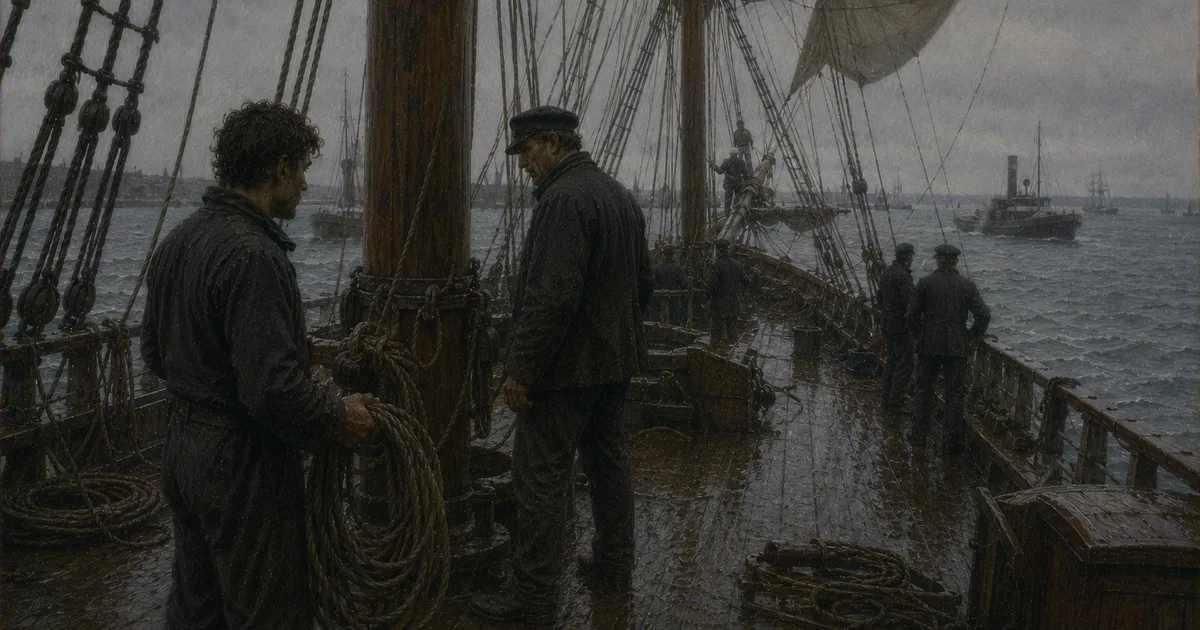
The American bark dropped her lines at the wharf at the noon tide of the Day Fifty-nine and went out under tow to the river-anchorage and from the river-anchorage out to the bar of the Elbe under the pilot.
Olav was at the foremast pin-rail.
He laid the coil at the cat-falls in the figure-eight he had been laying at every Norwegian-flagged ship since 1875 and at every ship he had been on since. The Swedish first mate was at the foot of the foremast at the deck-work of the run down to the bar. He looked at the coil. He did not say anything at the coil. He did not look away from the coil either. He looked at it for the time it took a man at the foot of the foremast to look at a coil at the cat-falls and decide what kind of a thing he was looking at, and then he looked at Olav at the pin-rail. Olav held the next coil at his hands. The Swedish first mate looked at the coil at the cat-falls again and went forward to the bowsprit-cap to look at the men at the running gear there.
He did not say.
The pilot brought the bark out to the bar at the change of the afternoon watch. The pilot left at the bar. The bark came onto the larboard tack at the change of the bells and set the topsails at the wind from the north-east and went out into the German Bight at the four bells of the first dog-watch.
The watches at the bark were the standard watches.
Olav was at the larboard watch under the Swedish first mate. The man called the Red Shirts was the second mate at the starboard watch. The boatswain went with the watch that was on deck. The captain went on his own counsel. The cook of the bark was a man Olav had not seen at the deck and could not see at the galley from the bunk at the forecastle.
The forecastle was at the lower end of the foredeck under the deck-house.
The bunks were the bunks of a forecastle of an American bark out of Hamburg with a salt cargo and German manufactured goods for New York. Olav had the lower bunk at the starboard side at the lower end. The Dane had the bunk above his. Across the row were the bunks of the two German wharf-hands who had come aboard at the gangway of the morning, who were of the wharf and were going to New York for the wage. At the upper end was the bunk of the French seaman, and the bunk above the French seaman’s was the bunk of the little Swede.
The bilge was under the bunks. The bilge of an American bark out of Hamburg with a salt cargo for New York had a smell.
Olav slept the first night at the bunk at the lower end at the starboard side. The Dane slept at the bunk above him. The Dane did not say anything to Olav at the bunk or at the climbing into the bunk or at the lying down at the bunk. The Dane breathed at the bunk above. The breath was the breath of a man who had been at the bunk-row of a coaster or a bark for many years.
The food at the bark was the food at the bark.
The cook brought it up from the galley to the forecastle table at the morning watch and at the noon and at the afternoon watch and at the change of the dog-watches. The morning food was a coffee that was not coffee and a bread that was a bread of the wharf. The noon food was a pea-soup of pea-soup days old at the bottom of a great kettle. The afternoon food was the noon food again, with the addition of a piece of salt meat that had been boiled in seawater because the cook had not the fresh water for the boiling. The food at the change of the dog-watches was the same.
The pea-soup had at the lifting of the spoon out of the bowl a layer of grease that was the grease of the pea-soup days old. The potato-peelings at the soup had the pork-rind bristles at the peelings that the cook had not taken off before putting the rind into the kettle. The men at the table ate the soup. They drank the coffee that was not coffee. They ate the salt meat.
The Frenchman at the table was at the lower end of the bench across from Olav.
He was a man past fifty in a black coat with a small scar at the cheek that was a scar of a cudgel and a longer scar at the side of the neck that was a scar of a saber. He had a butcher knife at his belt that was a knife of about eighteen inches at the blade. He kept the knife at the belt at the table and at the deck and at the bunk. He had been a sailor at the bark for the four voyages the Swedish first mate had been the first mate of the bark.
Olav ate the food the men at the table ate.
The first night at the bunk after the food he slept the sleep of a man who had eaten the food and had been at the deck under the Swedish first mate at the watch. The second night he slept the same sleep. The third night he slept the same sleep.
One of the German wharf-hands at the bunk across the row was sick at the morning of the fourth day.
He was at the bunk at the noon. He did not come to the table at the noon. He did not come to the deck at the change of the bells of the afternoon watch. The Swedish first mate at the foot of the foremast at the four bells of the afternoon watch said the German wharf-hand should come to the deck or come to the captain. The German wharf-hand came to the deck at the half hour after. He went aft to the cabin door under the poop. He stood at the cabin door and the boatswain at the gangway-end told the captain at the cabin that the hand was at the door. The captain came to the cabin door.
The captain looked at the German wharf-hand.
The wharf-hand said in the German of a Hamburg wharf-laborer that he had a sickness at his belly and the sickness was a sickness from the food at the table and he was asking for something for the sickness. The captain looked at the wharf-hand for the time it took a captain to look at a sick man at his cabin door, and then he went into the cabin. He came out half a minute after with a glass at his hand. The glass had a brown liquid at it. He held the glass out to the wharf-hand.
The wharf-hand took the glass.
The captain said in the English of a Massachusetts master that the hand should drink it.
“Drink this, and then go to work, and work as long as you live, and when you are dead I shall have you thrown overboard.”
The wharf-hand drank the glass. He gave the glass back to the captain. The captain went into the cabin and shut the cabin door. The wharf-hand went forward. He came to the deck-work at the half hour after.
Olav was at the foredeck at the running rigging at the four bells of the afternoon watch.
He had been at the deck-work and had looked up at the cabin door once. He had not looked at the cabin door a second time. The Dane was at the foredeck beside him at the larboard fife-rail. The Dane had been at the running rigging when the captain had given the glass. The Dane had not looked at the cabin door at all.
Olav did the deck-work at the four bells of the afternoon watch.
He went below at the change of the watch at the eight bells. He sat at the bench at the table at the forecastle for the off-watch. The Dane was at the bench beside him. The little Swede was at the upper end of the bench. The Frenchman was at the lower end of the bench. The boatswain was at the deck at the watch. The Red Shirts was at his own bunk aft.
Olav said to the Dane in Norwegian at the bench that the bark went well at the wind that had come round to the west at the four bells of the first watch.
The Dane said in Danish that the bark would have the wind at the beam at the morning.
The Frenchman stood up at the lower end of the bench.
He drew the butcher knife from the belt. He laid the knife at the table at the lower end beside his bowl, with the point at Olav and the haft at his own hand. He did not lift the knife. He kept his hand at the haft. The thumb was split at the second joint and had healed long. He spoke at the table in the English of a French seaman who had been at American barks for many years.
“Not a word but English to be used here. Look to your safety.”
The Frenchman did not lift the knife at the speaking. He kept the hand at the haft and the point at Olav and looked at Olav at the bench at the upper end. He did not look at the Dane. He looked at Olav.
The Dane did not move at the bench beside Olav. He did not speak. He did not stand up. He did not lay his hand at the table or at the bench or at his coat. He kept his hands at his knees at the bench and looked at the Frenchman at the lower end.
Olav said in English: yes.
The Frenchman waited at the table for some seconds. Then he picked up the knife at the haft and put it back at the belt and sat down at the bench at the lower end and ate the rest of his soup with the wooden spoon in the bowl.
The little Swede did not say anything at the upper end of the bench.
The Dane did not say anything at the bench beside Olav.
Olav ate the rest of his soup in the English that was not spoken at the bench because the bench was not speaking.
The forecastle of the bark was the forecastle of a bark with a French seaman from the south of France and a Danish able seaman from a Danish coaster and a Swedish cabin-boy adopted by a Swedish first mate from a previous regime and two German wharf-laborers and a Norwegian from Vestbø at Finnøy. The Lillesand-Norwegian second mate was at his own bunk aft of the deck-house. The German boatswain was at his own bunk aft of the deck-house. The Austrian steward was at the galley with the cook of the bark whose nationality Olav had not learned. The captain was at his cabin.
The bark had seven nationalities and no kinship.
Olav slept the fourth night at the bunk at the lower end at the starboard side. The Dane slept at the bunk above him. The Dane did not say anything to Olav at the bunk or at the climbing into the bunk or at the lying down at the bunk. The Dane breathed at the bunk above the way the Dane had breathed at the bunk above on the first night and on the second and on the third.
The bark went west at the wind from the north-west at six knots at the first week of the run from Hamburg to New York.
The figure-eight at the cat-falls Olav laid at every change of the watch on deck. He laid it at the cat-falls and the Dane laid it at his own, the way the Swedish first mate had not said the figure-eight should be laid but the way the figure-eight was laid at the cat-falls of an American bark out of Hamburg under a Swedish first mate of Gothenburg and a captain of Massachusetts who gave the brown glass to a man who said his belly was sick at the food.
The wind held at the north-west.
The bark went west.