Olav crossed to Lindøy at the first Sunday of the March.
He had not crossed to Lindøy in three weeks. The strait had been the reason of the first of the three Sundays, because the strait at that Sunday had not let a small boat cross. The strait had not been the reason of the second Sunday or the third. Olav had been at the room at Kindingstad’s at the second Sunday and the third with the chart-work at the table and the cod-liver oil at the small table at the side of the bed, and he had let the not-crossing of those Sundays be a thing that the household at Lindøy would set to the strait, because the strait was the reason a man could give and the other reason was not.
At the first Sunday of the March he crossed.
He had decided at the Saturday that he would cross. The cough at his chest had not gone off—it was at the chest the way it had been at the chest since the February, the small wet thing at the lower of it at the mornings—but the cough at the first week of the March was a cough Olav had come to carry the way a man carried a thing he had had three weeks to learn the carrying of, and Olav had decided at the Saturday that a man could not let a strait be the reason of the not-crossing for a fourth Sunday without the not-crossing becoming a thing of its own at Lindøy. He took the borrowed boat off the Stavanger wharf at the afternoon and rowed the strait.
The strait at the first Sunday of the March was a strait at the end of a winter. The cold of it was the cold of a March that had not yet turned. Olav rowed the four miles of it at the oars, and the rowing was a work the body did, and the cough came up at his chest twice at the rowing and he coughed it at the open water where the coughing of it was a thing of the open water and not a thing of a kitchen.
He came to the Lindøy boathouse at the dusk.
He went up the path at the slopes. The kitchen window of the house showed the lamp. He came to the south door and opened it.
Bertha was at the stove.
She turned at the door. She saw Olav at the threshold. And Olav saw, at the half-second of Bertha turning and seeing him, a thing pass at Bertha’s face—a thing that was not the thing that had passed at her face at the door at the borrowed-boat-nights of the autumn and the early winter, when Bertha at the door had seen a man come in from the strait and had said he would sit at the table and the soup was at the stove. Bertha at the door at the first Sunday of the March saw Olav at the threshold and the thing passed at her face, and she did not say what the thing was. She said the thing she had said at the borrowed-boat-nights of the autumn.
“You will sit at the table,” Bertha said. “The soup is at the stove.”
Olav sat at the table at the place at the east side.
Bjørn was at the parlor. He came to the door at the east wall at the few minutes with the pipe at his hand and said the strait had been a hard strait at the three weeks of the not-crossing, and Olav said it had, and Bjørn said a man did right not to take a small boat at a strait the strait did not give, and Olav said yes, and Bjørn went back to the parlor. He had given Olav the strait for the reason of the three weeks the way the household gave a man the reason that was the easy reason, and Olav had taken it.
Olava was at the chair at the side of the stove.
She had been at a thing of the household at her hands at the chair when the door had opened—a mending, a thing of the linen. She set it at the small table at the side of the chair. She came to the table and sat at the place at the south side at the side of Olav, the place she had sat at across the autumn and the early winter at the borrowed-boat-nights.
The evening at the Lindøy kitchen was the evening of a borrowed-boat-night the way the borrowed-boat-nights had been across the autumn and the early winter—the soup, the bread, the household at the Sunday-evening rhythm, Bjørn at the parlor, Bertha at the stove and then at the table. Olav ate the soup. He told the household the small things of the school, the chart-work, the examination that was at the first of the April. He coughed the cough twice at the evening, and at the coughing of it he said the strait had given him a cold at the crossing, and Bertha said a man took a cold at a March strait and the soup was good for it, and the household let the cough be the cold of a March strait the way the household let the three weeks be the strait.
Olav did not tell Olava about the cough.
He did not tell her about Dr. Due, or the office at the upper town, or the brown bottle of the cod-liver oil at the small table at the side of the bed at Kindingstad’s, or the not yet the doctor had said and the thing the not yet stood in front of. He did not tell her about the brother at the churchyard at Hesby. He sat at the table at the side of her and told the household the small things of the school and let the cough be a cold, and the not-telling was a thing Olav held at the kitchen the way he had held the not-naming at the room at Kindingstad’s at the nights of the February.
Olava did not ask.
She sat at the place at the side of him at the table. She had been at the man at the side of her for the near-three-years of the engagement and the letters and the summer and the autumn-and-early-winter of the borrowed-boat-nights, and she had a knowing of the body of him the way a woman had a knowing of the body of the man she would marry. Olav registered, at the table at the kitchen at Lindøy at the first Sunday of the March, that Olava had the knowing—that she had looked at the body of him at the table, at the face of him and the eating-of-him and the cough-of-him, and had seen that the body at the side of her at the table was not the body that had been at the side of her at the ice of Mosvannet at the December, and was not the body that had crossed the strait at the autumn borrowed-boat-nights.
She registered it. And she did not ask.
She did not ask why he had not crossed the strait in three weeks. She did not ask what the cough was past the cold-of-a-March-strait Olav had said it was. She did not ask what had changed in the body at the side of her. She sat at the place at the side of him and was at the not-asking the way she had been at the not-asking at the cafe at the Stavanger wharf-end at the July, and at the garden at Lindøy at the August, and at the pew at the Bethania at the December—the not-asking that was not a not-noticing, the not-asking that Olav had come to know as the shape Olava’s care took at a thing she had noticed and had decided to leave where the man had put it.
Olav sat at the table and registered the not-asking.
Bertha was at the table at the north side. Bertha had registered the thing at the door, and Bertha did not say it, and Bertha at the table at the north side of the kitchen registered, Olav understood, the thing Olava was registering at the south side—the two women at the one kitchen at the one Sunday-evening at the one not-saying, the mother and the daughter at the same kitchen not-saying the same thing to each other and not-saying it to Olav. Olav sat at the table between the two not-sayings and ate the soup and told the small things of the school.
He did not cross-name, at the kitchen at the first Sunday of the March, the not-telling at his own side and the not-asking at Olava’s. He held the not-telling. Olava held the not-asking. The two were at the one kitchen at the one table at the one Sunday-evening, and the kitchen held them both, and the household ate the supper.
It was a short evening.
Olav had the cross back to Stavanger at the early hours and the school at the morning, and the evening at the kitchen was the hour and the part of an hour after it that a borrowed-boat-night evening was. Bertha set the bread and the cheese for the boat at a cloth. Bjørn came to the kitchen door from the parlor and said good-night and said Olav was to row the March strait with the care a March strait wanted, and Olav said yes. Olava stood from the table.
“I will walk down with you,” she said.
Olava walked with Olav down the path to the boathouse.
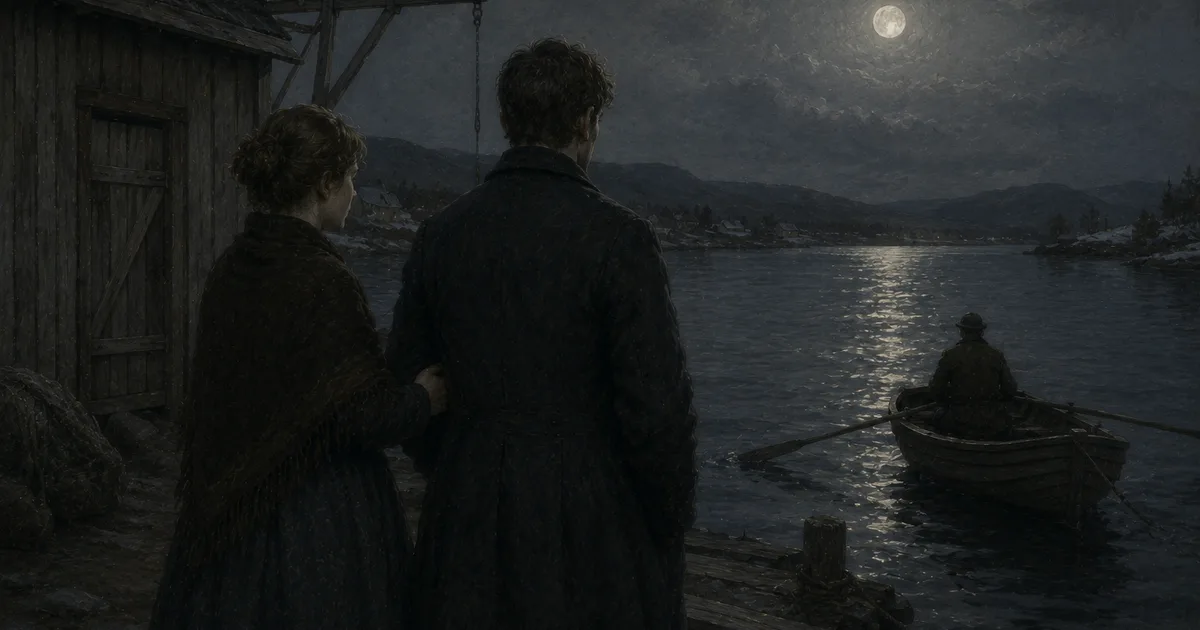
The path at the slopes at the night of the first Sunday of the March was at the cold and the dark, with a moon at the strait that put a light at the water. Olava walked at his side. She did not speak at the walk down. They came to the wharf at the lower end of the boathouse, and Olav put the borrowed boat off the wharf and set the bread-and-cheese cloth at the thwart, and he stood at the wharf-edge at the boat.
Olava stood at the wharf-edge at the arm’s-length from him.
She did not say what she had not said at the kitchen. She put her hand at the sleeve of Olav’s coat at the forearm. She had put her hand at his arm at the ice of Mosvannet at the crook of his elbow, at the December afternoons, at the lightness of a hand at a man’s arm at the skating; and the hand at the sleeve of his coat at the wharf-edge of the Lindøy boathouse at the night of the first Sunday of the March was not the hand at the crook of the elbow at the ice. It was a hand laid at the forearm of his coat. She laid it there, and she held it there, and she held it there for the length of time that was longer than the length of time a hand was laid at a parting at a borrowed-boat-night, and she did not say what the hand-laid was for.
Olav stood at the wharf-edge with Olava’s hand at the sleeve of his coat.
He did not say what the hand-laid was for either. He had a knowing of what it was for. It was for the thing Olava had registered at the table and had not asked after—the hand-laid was the not-asking made into a thing of the hand, the care that did not ask put at the sleeve of his coat at the wharf-edge where the asking would have been if Olava had been a woman who asked. Olav stood and let the hand be at his sleeve. Then Olava took the hand off, the way she had taken her hand off his arm at the courtyard at Landa at the June of 1876 after the four words, because the next thing was the boat and the strait.
“Row carefully,” Olava said.
“I will row carefully.”
Olav took the boat out at the oars into the strait.
He rowed the borrowed boat across the moonlit strait toward the lights of Stavanger at the lower end of the upper harbor. The cough came up at his chest at the middle of the strait and he coughed it at the open water. The body of him at the oars at the moonlit strait was the body that had been at the kitchen at Lindøy at the not-telling and the not-asking, and that had stood at the wharf-edge with Olava’s hand at the sleeve of its coat, and Olav rowed it across the strait at the dark, and the moon was at the water at the larboard side, and the lights of the city came up large at the bow.
He came to the Stavanger wharf at the small hours. He made the boat fast. He walked up to Kindingstad’s at the streets.
He came to the third-floor room. He did not light the candle. He lay at the bed at the room at the early hours of the Monday of the first week of the March, with the brown bottle of the cod-liver oil at the small table at the side of the bed, and the borrowed boat tied at the wharf at the lower streets, and the school at the chart-work at the three hours ahead.