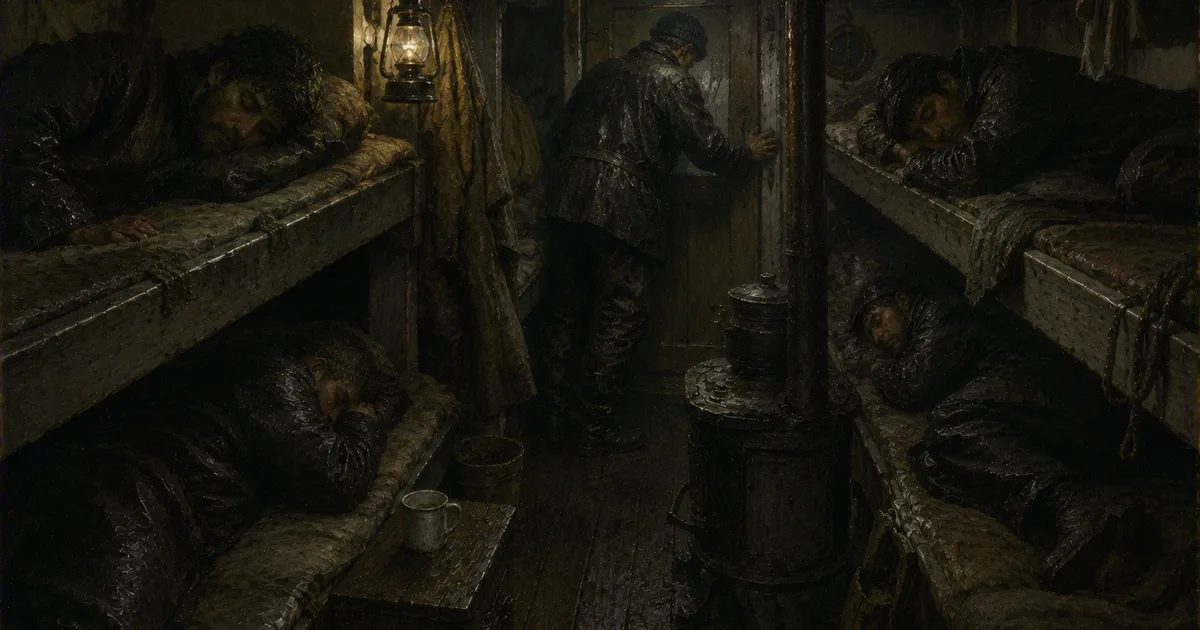
The six-and-two had become what the Kvik was.
The watch on deck had been at the bars and the watch below had been at the bars for seventeen days at the change of the four bells of the morning watch on the Day Twenty-two of the southerly run, which was the fifteenth of January of 1878. The bars were six hours on and two hours off. The bunk was the bunk a man came to after the bars and was the bunk a man went from to the bars. The oilskins did not come off at the bunk. The men slept at the oilskins.
The waterlogged feeling Olav had not known at any prior voyage was the feeling of a man who had not been dry in his clothes or in his bedding for seventeen days, and it was akin to the seasickness of his first run on the Sigrid of June of 1875 when he had been at the rail for three days before his stomach had come to the rate of the ship. The seasickness had eased at the third day. The waterlogged feeling did not ease. It was the Kvik under his clothes.
He lay at the bunk for the two hours of the eight bells of the night watch with his oilskins at his body and the wool of his shirt wet through his oilskins and the wool of his stockings wet through his boots that he had not taken off at the bunk for the nine days the captain had set the boots-on rule under the cold of the latitudes the Kvik had not yet come out of. He did not sleep through the two hours. He lay with his eyes closed and the body’s heat slowly drying the wool from the inside out, the way a man was at a bunk in a Kvik at the six-and-two. The forecastle was the smell of wet wool and tallow and the bilge that the bars had not brought lower and would not bring lower until the Kvik came to Hamburg. It had been the smell of the forecastle for seventeen days. A man came to a smell at the third or fourth day and did not come to it again.
He came on deck at the change of the four bells of the morning watch.
He pumped at the Kvik’s rate. Thomas was at the other bar of the first pump. The Hamar man and the Stavanger carpenter were at the bars of the second pump. The boatswain was at the bilge-pump-hatch with the rod at his hand. The rod read four inches above the noon-marking of the previous day at the six bells of the morning watch.
The four inches was the level the rod had read at the six bells of the morning watch on the Day Twenty-one and the Day Twenty and the Day Nineteen of the southerly run. The bars kept it. The bars did not bring it lower. That was the work the bars did on a Drammen bark with a leak-with-the-sea at the bow on the fifteenth of January in the latitude of the trades.
The watch went on through the bells.
Each man at the bars was the man he had been at the bars at the first morning of the six-and-two and the man he was not. Thomas at the other bar of the first pump pumped the way he had pumped on the Dronningen in the November of 1876 on the Atlantic crossing, but Thomas at the Kvik had a way of holding his shoulders at the bar that he had not had on the Dronningen. The Stavanger carpenter at the second pump pumped at the rate of a man of forty-five who had been at the bars of a Hamburg-Stavanger trader for ten years before he had come to the Kvik. The Hamar man at the second pump pumped at the steady stroke he had come to at the third day of the six-and-two after the gale and had held since. The Drammen-born young hand was at the wheel at the second dog-watch and at the bars of the morning watches of the days he was not at the wheel.
The boatswain was at the bilge-pump-hatch.
He had been at the bilge-pump-hatch from the four bells of the morning watch of the Day Five when the first gale had come down and the six-and-two had begun. He had read the rod at the six bells of every watch through seventeen days and laid it back in its place. He had not said what the rod said at any of the readings. He had pumped at the bars in his own rotation of the watch on deck. He had stood at the side of the pumps for the strokes a man at the bars could not give. He had slept at the cabin for two hours at the change of the watches he was not on deck.
He slept in the cabin and not at the forecastle because the captain had said at the second day of the six-and-two that the boatswain should be at the cabin between the watches in case the bilge gave a thing in the night that wanted a man at the wheel-box. The boatswain had said yes. He had not slept the longer hour the cabin offered him. He had slept the two hours the watch off offered and had come back to the bilge-pump-hatch at the change of the bells. He did not look at the men at the bars to see if the men were at the rate. They were.
That was the work the boatswain of the Kvik did.
The captain came forward to the bilge-pump-hatch at the change of every watch and stood at the side of the pumps for a minute and went aft to the wheel-box.
The night of the Day Twenty-four came down on the easterly run.
The wind that had been at the southwest for the southerly run had come to the south at the Day Eighteen and then to the east at the Day Nineteen as the Kvik had come to the latitude of the trades, and the bark had been on the easterly run since the second dog-watch of the Day Nineteen, going east at six knots in the trade. The sea was the long swell of the trade. The bark went east at six knots through the first watch and the middle watch.
The deck cargo broke free at the four bells of the middle watch.
The foredeck cargo of the Kvik was a deck cargo of eight resin barrels lashed at the foredeck with a hemp lashing that had been put on at Wilmington and had been wet through the nineteen days of the gale-and-then-six-and-two. The hemp at the lashing had given at the four bells of the middle watch under the work of a sea that had come over the larboard bow at the lift of the bark to the next sea. The lashing parted at the upper end. The barrels at the upper end of the lashing rolled at the soft-wood deck of the foredeck.
The first barrel rolled to the larboard rail and stopped at the rail.
The second barrel rolled to the larboard rail and stopped at the first barrel.
The third barrel rolled to the larboard rail and went over.
Olav was at the bars of the first pump when the third barrel went over the larboard rail.
The boatswain at the bilge-pump-hatch had heard the rolling on the foredeck before the first barrel had gone over. He had not heard it as a rolling that was a thing to call the watch on deck for. He had heard it as a rolling that was a thing for a man to go to. He said to Olav at the bars to come off the bars and go forward to the foredeck. Olav came off the bars and went forward.
Thomas at the other bar of the first pump pumped alone for the change.
The four bells of the middle watch had been struck at the boatswain’s stroke at the bilge-pump-hatch when Olav had been at the bars and the rolling had been at the foredeck. The four bells were not the bell that called the watch on deck. The barrels at the foredeck had been eight barrels at the upper end of the lashing and had been one of eight that had gone over the rail before Olav had come to the foredeck.
Seven barrels were at the foredeck rolling.
A barrel of resin was the weight of two hundred pounds and a barrel of resin at the foredeck of a soft-wood bark at the lift of a bark to a sea was the weight of two hundred pounds going where the lift sent it. A man at the foredeck got his hands at the lower stave of the barrel and lifted at the lift and went with the barrel to the rail. The barrel went over at the next lift. A man at the rail did not stand at the larboard side and wait for the next barrel to come to him. A man at the rail went to the next barrel where the next barrel was.
He went to the rail at the larboard side and got his hands at the lower stave of the first of the seven barrels and put it over.
He went to the next barrel and got his hands at the lower stave and put it over.
He went to the next barrel and got his hands at the lower stave and put it over.
The fourth barrel was at the deck near the foremast on the starboard side, having rolled across the deck at a lift of the bark to a sea. He went to it. He got his hands at the lower stave. He rolled it to the starboard rail. He put it over.
The fifth barrel he got at the larboard rail.
The sixth barrel he got at the larboard rail.
The seventh barrel had rolled aft to the deckhouse and had lodged at the corner of the deckhouse at the larboard side. He went aft to the deckhouse. He got his hands at the lower stave. He rolled it forward to the larboard rail at the foredeck at the lift of the bark to the next sea. He put it over.
The foredeck was clear at the eight bells of the middle watch.
The hemp lashing at the foredeck was at the deck in two pieces of hemp that had been a lashing. The boatswain came forward at the eight bells. He looked at the lashing. He looked at the deck. He looked at Olav at the rail. He went aft.
Olav came aft to the bilge-pump-hatch and took the bars again at the change of the bells.
The galley cooking-gear washed overboard at the first watch of the Day Twenty-five.
A sea came over the larboard quarter at the change of the four bells of the first watch, and the galley door at the deckhouse at the after part of the foredeck broke at the upper hinge under the weight of the sea. The sea went into the galley and went out of the galley with the galley cooking-gear. The cook, who was a man of fifty-five who had been the cook of the Kvik for four voyages and was a man of the Kvik the way the boatswain was a man of the Kvik, was at the galley at the change and was at the galley after the sea. The galley pots had gone over with the sea. The galley pans had gone over with the sea. The kettle had not gone over but had lost the bail at the top.
The cook had a coffee-pot and the coffee-pot had a bail.
The coffee-pot was the only pot at the galley after the four bells of the first watch. The cook said to the captain at the change of the watch that he could make coffee at the coffee-pot and could not make a hot meal at any pot the galley had. The captain said the men would have coffee at the watch-changes and hardtack and salt meat at the bunk for the rest of the voyage to Hamburg. The cook said yes.
The hardtack and the salt meat were what the men ate at the bunk for the rest of the voyage to Hamburg.
The coffee was what the men drank at the watch-changes.
The coffee was hot and strong and bitter, and the cook gave a man a cup at the change of the bells. The cup was the warm thing the Kvik had after the galley pots had gone over with the sea, and a man held the cup at his hand at the change of the bells for the time it took to drink the coffee and the time it took for the warm of the cup to come into the hand the man held it with.
It was at the third change of the bells that Olav had a cup at the bilge-pump-hatch and stood with the cup at his hand for a minute before he drank.
Bertel had been a man of twenty-five on the Dronningen on the Atlantic crossing of November of 1876 who had been at the bilge-pump-hatch with Olav at every watch when the Dronningen had been in the work of a long sea. The Dronningen had not been at a six-and-two. Bertel had a wife at Tau whose name was Birgit. At every port Olav had been at with Bertel, Bertel had set a small box at the chest of his bunk that was a box for Birgit.
Olav drank the coffee at the bilge-pump-hatch.
He went back to the bars at the change of the bells.
The Hamar man went to his knees at the bars of the second pump at the first watch of the Day Twenty-six.
He had been at the bars for twenty days and had been to his knees four times. The first had been on the night of the gale. The second had been on the third night of the six-and-two. The third had been on the seventh night. The fourth was the first watch of the Day Twenty-six.
Olav came across from the first pump.
He laid his hands at the Hamar man’s arms under the elbows and lifted. The Hamar man came up. Olav stood him at the bar and gave the strokes the Hamar man’s arms could not give. The Hamar man came to the rhythm at the third quarter hour. The boatswain at the bilge-pump-hatch said nothing.
It was the work the watch did at the bars of a Drammen bark with a leak-with-the-sea at the bow.
The Hamar man went to his knees a fifth time at the second dog-watch of the Day Twenty-eight. Olav came across from the first pump and lifted at the elbows. The Hamar man came to the rhythm at the third quarter hour. The boatswain at the bilge-pump-hatch said nothing.
The Day Twenty-six went to the Day Twenty-seven.
The Day Twenty-seven went to the Day Twenty-eight.
The trade held at the easterly run.
The bilge-rod read four inches above the noon-marking at the six bells of every morning watch through the Day Twenty-eight and the Day Twenty-nine and the Day Thirty.
The boatswain at the bilge-pump-hatch read the rod at every change and laid it back in its place and did not say what the rod said. The captain came forward at every change of the watch and stood at the side of the pumps for a minute and went aft. The watch on deck pumped at the Kvik’s rate. The watch below pumped at the Kvik’s rate. The bunk was the bunk a man came to after the bars and was the bunk a man went from to the bars. The oilskins did not come off at the bunk.
A man at the bars at the third week of the six-and-two did not count the days of the voyage to Hamburg by the days. He counted them by the watches at the bars and by the cups of coffee at the change of the bells and by the level of the rod the boatswain read and laid back without saying. The count was a count a man at the bars came to without setting himself to come to it. The count was the work the bars did.
The bars went up and the bars went down.
The Kvik of Drammen went east at six knots in the trade through the night of the Day Thirty.