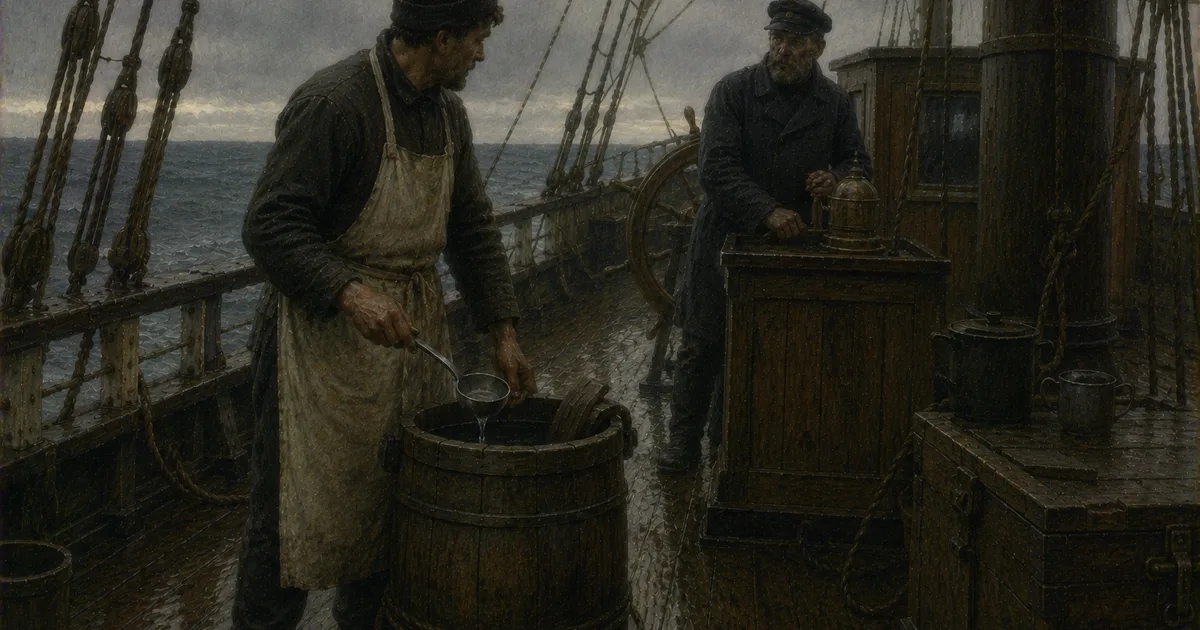
The water at the cask at the foredeck was salt on the morning of the Day Thirty-three.
The cask at the foredeck was the small wooden cask the cook dipped at for the coffee at the watch-changes and for the salt-meat boiling in the kettle at noon. The cook tasted the dipper at the half past six of the morning and set the dipper back at the cask. He went aft to the captain at the wheel-box and said the water was salt at the cask.
The captain came forward to the cask at the foredeck at the seven of the morning.
He tasted the dipper. He set the dipper back. He said to the boatswain at the foremast pin-rail that the cask was from the deck-tank below the foredeck and the deck-tank had gone salt from the leak-with-the-sea at the bow. The boatswain went forward to the hatch over the deck-tank and lifted the hatch and dipped a fresh dipper at the upper end of the tank. He tasted. He set the dipper back. He said yes.
The deck-tank was the larger of the two water-tanks the Kvik carried for the voyage. The second tank was the after-tank below the cabin and held three-quarters of the deck-tank’s water. The captain said the after-tank would be the water for the rest of the voyage and the after-tank would be at the pint rations for the men of the crew until the Kvik came to a rain that filled the deck-tank again.
The boatswain said yes.
The cook said yes.
The pint rations began at the noon of the Day Thirty-three.
A pint of water for a man at the watch-change was the water for the cup of coffee and the water for the salt in the salt-meat at the bunk, and was not a pint of water for anything besides. A man’s thirst at a pint of water at four watch-changes of the day was not a thirst a man at the bars of the Kvik at the six-and-two had been at before.
The Day Thirty-three went to the Day Thirty-four.
A man at the bars at the pint rations went to the bars with the salt at his mouth from the salt-meat at the bunk and the salt at his sleeves from the sea at the deck and the salt at the wool of his coat from the twenty-nine days of the wet that had been at the wool. The pint of water at the watch-change was not enough water for the salt the man went to the watch-change with. The body of a man at the bars was the body of a man who had been at a pint of water at four watch-changes of the day for two days. The bars went up and the bars went down.
The bilge-rod was at five inches above the noon-marking of the Day Two at the six bells of the morning watch of the Day Thirty-four.
The four inches that the rod had held at the six bells of every morning watch for sixteen days had become five inches because the men at the bars had been at a pint of water for two days and the strokes the men at the bars gave were not the strokes the men had given before the pint rations.
The boatswain at the bilge-pump-hatch read the rod and laid it back without saying.
The captain came forward to the bilge-pump-hatch at the six bells. He looked at the rod. He looked at the bars. He went aft.
The rain came at the second dog-watch of the Day Thirty-five.
A bank of cloud had come up at the north at the four bells of the afternoon watch. The wind that had been at the east in the trade for sixteen days had backed to the north-east at the eight bells of the afternoon watch, and the bark had been at the close-haul under reefed topsails and the staysails from the change of the dog-watches. The squall that came over the larboard bow at the four bells of the second dog-watch was the squall that brought the rain. The rain came at heavy at the second dog-watch and held heavy at the first watch and was heavy still at the middle watch.
The captain had ordered the deck-tank’s hatch open at the first sign of the rain at the four bells of the second dog-watch. The cook had brought up the spare buckets from the galley and had set them at the lee of the foremast and at the lee of the deckhouse and at the lee of the bilge-pump-hatch. The boatswain had set the canvas at the deck-tank to catch the rain at the funnel of the canvas down into the hatch. The watch on deck set the second canvas at the after-tank.
The deck-tank filled at the first watch.
The after-tank filled at the change of the middle watch.
The buckets at the deck filled at the watch-changes and the cook came up at every change to take the full buckets to the galley.
The captain came forward to the cook at the galley door at the four bells of the middle watch and said the rations would be at the full from the next noon. The cook said yes.
Olav came up from the bunk at the change of the four bells of the middle watch of the Day Thirty-six.
The rain at the middle watch had eased to a steady fall. The bark was on the easterly run again with the wind back to the east at the change of the morning watch and the deck-tank full and the after-tank full and the buckets at the deck full. The watch on deck was at the bars at the bilge-pump-hatch amidships. The watch below was at the bunks. The captain was at the wheel-box. The boatswain was at the cabin.
Olav went forward at the half hour of the two-hour bunk.
He had been at the bunk for the first half of the two hours. He had not slept. The rain at the deck had been a sound at the planks of the bunk-shelf above him and the sound of the rain at the planks had been the sound of the deck-tank filling. He had got up at the half hour and put on his coat at the bunk and gone out of the forecastle to the deck.
The deck was wet at the rain that had eased to a steady fall.
He went forward to the foremast pin-rail and from the foremast pin-rail to the anchor windlass at the foredeck.
The anchor windlass was a wooden barrel of oak the length of a man’s reach and the height of his thigh, with iron bands at the upper end and the lower end and an iron pawl at the side. The chain that came up from the anchor at the larboard hawse-pipe lay coiled at the chain-locker at the larboard side of the windlass and the chain at the starboard hawse-pipe lay at the chain-locker at the starboard side, and the windlass stood between them.
He knelt at the windlass at the change of the bells.
He laid his forearms at the upper end of the windlass at the ridge where the oak had been worn by the chain at the lifts of the anchor. The iron band at the upper end of the windlass was cold through the wool of his coat-sleeves at his forearms. The wood of the windlass was wet at the rain. The rain at his back was steady. The night at the open Atlantic at the easterly run was dark at the change of the bells of the middle watch.
He did not speak.
He did not name to himself what he was at the windlass for.
He laid his forearms at the ridge of the wood and the iron and held them at the wood and the iron for the count of breaths he held them for. He did not count the breaths. The breaths were the breaths a man at a windlass at the second hour of the night at the rain of the open Atlantic took without counting.
He laid his hand at the inside-pocket of his coat where the spare shirt’s button-pocket had been at the side.
He did not take the rosary out. He did not pray the rosary because he was not a Catholic and the rosary was not the prayer he had been brought up on, but the rosary was at his pocket and his hand at the pocket was a hand at a thing Margit O’Brien had given him at the upper end of Wilmington on the morning of the Christmas Day of 1877. He took his hand off the pocket.
The psalm at his head was the psalm of the men who went down to the sea in ships, and the psalm at his head was the psalm he had learned at the confirmation at Hesby in the spring of his fifteenth year.
He did not speak the psalm.
His mother had read at him from the gospel of John at the small back room at Vestbø in the spring of his sixth year, in the spring before she had died.
He knelt at the windlass for the second hour of the two-hour bunk.
He did not stand at the eight bells of the middle watch. He stood at the change of the bells when the watch above came down and the watch below went up. He laid his forearms at the upper end of the windlass for the count of breaths he laid them at the windlass for. He took his forearms off the windlass at the change of the bells.
He went aft to the bilge-pump-hatch and took the bars at the change.
The bars went up and the bars went down.
The Day Thirty-seven came at the change of the four bells of the morning watch.
The Day Thirty-seven went the way of the Day Thirty-six.
The night of the Day Thirty-seven Olav went forward at the half hour of the two-hour bunk of the change of the four bells of the middle watch as he had gone forward on the night of the Day Thirty-six.
He knelt at the windlass.
He laid his forearms at the upper end. He did not speak. He laid his hand at the inside-pocket and took it off without taking the rosary out. He stood at the change of the bells and went aft to the bars.
The Day Thirty-seven went to the Day Thirty-eight.
The Day Thirty-eight went to the Day Thirty-nine.
He went forward at the half hour of the two-hour bunk of the change of the four bells of the middle watch on the nights of the Day Thirty-seven and the Day Thirty-eight and the Day Thirty-nine and the Day Forty and the Day Forty-one of the southerly-and-then-easterly run, and he knelt at the windlass at every night.
The boatswain at the cabin and the captain at the wheel-box did not see him at the windlass at the second hour of the night.
The watch on deck at the bars at the bilge-pump-hatch amidships did not see him at the windlass at the second hour of the night.
He did not know what was at the windlass at his kneeling.
He did not know what was in the breaths he took at the windlass, or in the count he did not count.
He did not know what the rain had done.
The bars went up and the bars went down.
The Kvik of Drammen went east at six knots in the trade through the nights of the Day Thirty-seven and the Day Thirty-eight and the Day Thirty-nine and the Day Forty and the Day Forty-one.