The path at the upper end of the boathouse rose along the slopes of Lindøy at the long light of the four of the afternoon.
Olav walked up the path at Olava’s side. He had the small bag at his left hand. He had the umbrella-as-cane at his right hand. He had the brown wool of the Bordeaux suit at his shoulders.
The path was the path Olav had walked down at the second week of July of 1876 at the Sunday afternoon Olava and Bertha had walked Olav down to the boathouse at the parting before the steamer back to Stavanger. He had not walked up the path at any of the days since. He walked up the path now.
The slopes at the upper end of the boathouse went up at the gentle rise of the lower end of Lindøy to the first ridge that ran across the island at the southerly half. The grass at the slopes was the green of late July at a Norwegian-coast island that had not had a dry month at the spring. The path was a path of two cart-widths at the lower end and a path of one cart-width at the ridge.
Olava walked at his side at the right.
She did not speak at the walk up.
He did not speak at the walk up.
The path came over the ridge at the four and ten minutes of the afternoon.
The house was at the lower side of the ridge at the upper end of the slope that ran down to the small bay at the northerly side of the island. It was a house of two stories at white-painted clapboard with a small black-painted door at the south side and a small black-painted door at the north side and a slate roof of the kind a Norwegian-island fisherman of the year 1850 had set on a farmhouse he had built when the fishing had been good. The chimney was at the upper end of the slate roof at the south side. The smoke at the chimney was the smoke of the kitchen stove at the supper.
Olava stopped at the path at the upper end of the house at the few paces from the door.
She turned to Olav.
She said: This is the house.
Olav said yes.
She walked at his side at the few paces to the south door.
She opened the door.
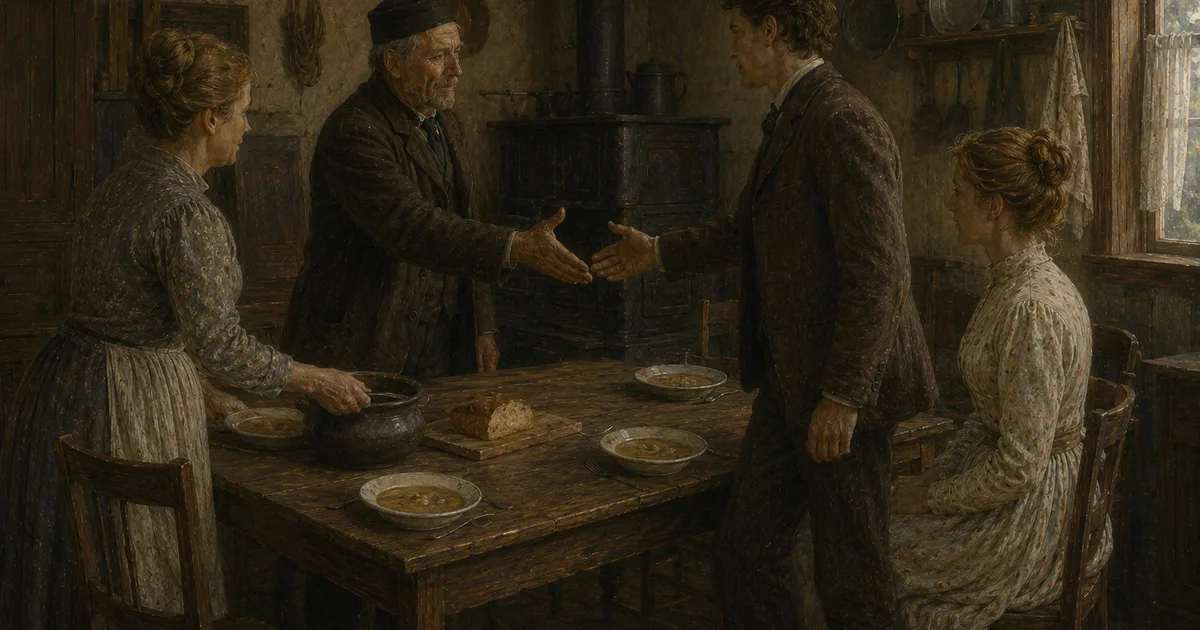
The kitchen at the lower side of the south door at the lower floor of the house at Lindøy at the four and a quarter of the afternoon of the twenty-seventh of July of 1878 was a kitchen of a Norwegian-coast farmhouse of the year 1850 that had been a kitchen at the same room for the twenty-eight years since. The stove was at the north wall. The table was at the middle of the room. The cutting-board was at the table. The chairs were at the table at the four places at the four sides. The shelves were at the east wall with the cups and the bowls and the pitcher and the small dishes. The window was at the west wall at the side of the stove.
Bertha was at the stove.
She turned at the door.
She saw Olav at the door at the few paces from the threshold.
She did not say what Olava had said at the wharf at the noon. She said in the Stavanger-Norwegian of a woman of fifty-six at the kitchen of her own household at the Lindøy of the year 1878 that Olav was welcome at the kitchen and at the house.
Olav said in the Norwegian of the Hesby of his confirmation that he thanked her for the welcome.
He set the small bag at the chair at the side of the door. He took the brown hat off his head. He set the hat at the small shelf at the side of the door. He set the umbrella-as-cane at the corner at the side of the shelf.
Bertha set down the wooden spoon at the side of the stove.
She came across the room to the door.
She put her hand at his shoulder for the half a second of a hand of a mother-not-his-mother at the shoulder of a young man who had come at the door of her house, and she took the hand off at the half a second.
She said: You will sit at the table.
Olav sat at the chair at the table at the east side at the place Olava set the bowl for him.
Olava set the bowl at the place. She set the small loaf of bread at the cutting-board at the middle. She set the butter at the small dish at the side. She set the cup of the milk at the place.
Bertha set the soup at the bowl from the iron pot at the stove. It was a soup of barley and the small green peas of the late July and a piece of cured pork from the leg the household had at the cool room at the lower end of the upper story.
Bertha said: Bjørn is at the parlor.
Olava said: I will tell him.
She went through the door at the east wall to the parlor at the side of the kitchen.
Bertha sat at her place at the table at the north side. She did not eat the soup. She set the spoon at the rim of her bowl.
She said: Olav, you have come at the day we have been at the wait of for the long time.
Olav said yes.
She said: The household is at the welcome of you. Bjørn is at the welcome. Olava is at the welcome. I am at the welcome.
Olav said yes.
He did not say anything else.
She did not say anything else.
She took up the spoon and ate the soup at the bowl.
Olav ate the soup at the bowl.
Olava came back through the door at the east wall. She said Bjørn would come at the kitchen at a few minutes. She sat at the place at the south side at the side of Olav. She ate the soup at the bowl.
Bjørn came at the door at the east wall at the few minutes of his hand on the door-frame and his step at the threshold.
He was a man of fifty-eight at a coat of brown wool of a cut a Lindøy fisherman had worn at the year of 1860. He had the pipe at his hand at the right side. He had the small black cap at his head.
He came to the table.
He stood at the head at the north side at the side of Bertha.
He said: Olav. You have come at the day.
Olav stood at the chair.
He said: I have come at the day.
Bjørn put out the right hand at the side of the pipe. Olav took the hand. The hand was the hand Bjørn had put out at the parlor of the boardinghouse at Bredalmendingen at the half past three of the Thursday afternoon of the first week of July of 1876 at the time Olav had come to ask Bjørn Olsen Lindøy for the leave to write to Olava at the Dronningen voyage. The hand was the same hand. The pipe was a different pipe.
Bjørn sat at the chair at the head of the table.
He put the pipe at the small dish at the side of the place.
Bertha set the bowl of soup at his place.
He ate the soup.
The kitchen at the four and the half of the afternoon of the twenty-seventh of July of 1878 was the kitchen of the Lindøy household at the supper hour at the day of the homecoming of the man Olava had been at the wait of since the eighteenth of July of 1876.
Olav did not speak at the supper after the welcoming.
Bertha did not speak at the supper after the welcoming.
Bjørn did not speak at the supper after the hand at the table.
Olava did not speak at the supper.
The supper was at the half hour.
After the supper Olava took Olav to the small back room at the upper end of the upper story at the side of the kitchen. The room was a room of one window at the east wall and a bed of pine wood at the north wall and a chest at the foot of the bed and a chair at the side of the bed. The window looked at the east toward Roalsdyret across the strait.
Olava said: This is the room.
Olav said yes.
She set the small bag at the chair at the side of the bed. She set the brown hat at the small shelf above the chair. She did not say what she had at the half-minute at the door.
She went out at the door.
Olav stood at the room at the half-minute after she had gone out.
He stood at the window at the east wall.
The strait at the east of the upper window at the half past five of the long July afternoon was the green of a summer water of the Stavanger fjord. The slopes of Roalsdyret across the strait were the green of a summer slope. The light at the upper window was the light of a late-July evening at the latitude of Finnøy.
He did not look at the small back room at the things at the chest and at the chair and at the bed.
He looked at the window at the slopes across the strait.
He stood at the window for the few minutes.
Then he went out at the door to the kitchen.
The Sunday of the twenty-eighth of July came at the kitchen at the half past six.
Bertha was at the stove with the kettle.
Olava was at the bread-cutting-board with the loaf.
Olav was at the chair at the table at the place Olava had set for him at the east side.
Bjørn was at the place at the head at the north side.
The breakfast was bread and butter and the coffee that Olava made at the seven of the morning.
After the breakfast they walked to the wharf at the lower side of the boathouse for the Lindøy boat that crossed to the chapel at Rossøy at the morning of the Sunday.
Gustav came down from the upper house at the south side of the island. He was at the small black coat of the Sunday at his shoulders and the small black cap at his head. Margrete came at his side at the long dress of a Sunday at Lindøy. The three children came at the side at the order of the eldest at the right hand of Margrete and the second at the left hand and the third at the right hand of Gustav. The eldest was a girl of six. The second was a boy of four. The third was a boy of two who held Margrete’s hand at the path.
Gustav came to the boathouse.
He saw Olav at the wharf at the boathouse.
He came to Olav.
He put out the hand the way Bjørn had put out the hand at the kitchen. Olav took the hand.
Gustav said: I am glad you have come, brother.
He said brother in the Stavanger of a man of thirty-one of a Lindøy household at a wharf at his own island.
Olav said yes.
He said he was glad to have come.
Margrete came at her hand. She did not put out the hand the way Gustav had. She nodded at Olav at the half-bow of a wife of thirty at her husband’s brother-in-law-to-be at the wharf at her own island. Olav nodded back.
The children stood at the side of Margrete and looked at Olav at the long looking of small children at a man who had come from far at a brown wool of a foreign port.
The Lindøy boat sailed at the eight of the morning.
The crossing to Rossøy was at the half hour.
The chapel at Rossøy was at the upper end of the village at the harbor. It was the wood chapel of the year 1837 with the small bell at the side and the stove at the back wall and the pews of pine wood that had been pews for forty-one years.
The Lindøy family sat at the third pew from the front.
Olav sat at the side of Olava at the third pew from the front. Bertha sat at the side of Bjørn at the right end of the pew. Gustav sat at the side of Margrete at the left end. The three children sat at the lap and at the bench at the side of Margrete.
The pastor at Rossøy was a man of forty-eight who had been at the Rossøy pulpit for nine years.
He read the first reading at the morning of the Sunday of the twenty-eighth of July. He read the gospel. He gave the sermon. He read at the prayer-list the names of the sailors of the parish who were at sea at the summer and asked the parish to pray for them. The names were eight. Olav Hestby was not at the eight. The pastor read the eight names. The pastor did not read the name of Olav Hestby because Olav Hestby was at the third pew from the front at the side of Olava Lindøy at the morning of the Sunday of the twenty-eighth of July of 1878.
Olava sat at his side at the prayer-list.
She did not look at him at the prayer-list.
She looked at the pew rail at her hand at the cuff of her glove at the second knuckle.
Olav looked at the pulpit.
The pastor finished the prayer-list and gave the closing prayer.
After the service the family stood at the porch for a few minutes with the pastor’s wife at the porch step. The pastor’s wife said to Olav that the parish had prayed for him at every Sunday of the twenty-four months since the Dronningen had sailed and that the parish was glad he had come home. Olav thanked her. Bertha thanked her at his side.
The Lindøy boat sailed back at the noon.
The Tuesday of the thirtieth of July came at the upper house at the south side of the island.
Olav walked across the island with Olava at the morning. The path went south from the household house at the lower side of the ridge to the upper end of the south side where the upper house of Gustav and Margrete was at the south slope above the small bay at the south end of the island. The walk was a half hour at the morning of a late-July day at the green of the slopes at the dry of the summer.
Margrete was at the kitchen at the upper house at the coffee at the half past ten.
The kitchen at the upper house was a smaller kitchen than the kitchen at Bertha’s. The stove was at the north wall. The table was at the middle. The window at the south wall looked at the small bay at the south end of the island. The children were at the yard at the south side of the house at the play of three children on a summer morning.
Margrete set the coffee at the table at the three places.
She did not say what Bertha had not said. She set the coffee. She set the small slice of cake of the kind a Lindøy household kept at the cool corner for the Sunday and the few days after. She sat at the place at the north side.
Olav sat at the place at the south side at the side of Olava.
Margrete asked Olav about the Bordeaux suit at his shoulders. Olav said the suit was a suit a tailor at the Rue Sainte-Catherine at Bordeaux had made at the first week of July of 1878 at the discharge wages of an American bark that had been at the Brooklyn anchorage and at the loading of the petroleum at the Staten Island wharf and at the run across the Atlantic to Bordeaux. He did not say what the discharge had been worth. He said the suit had been the suit a sailor at the discharge bought at the Rue Sainte-Catherine at the half-day at the boardinghouse at the Cours du Chapeau-Rouge.
Margrete said: You are at the look of a Bordeaux man.
Olav said yes.
He did not say what he had not said.
Gustav came in at the door at the half past eleven from the byre at the upper end of the small bay where the household kept the boat at the herring.
He sat at the table. He took the coffee at the cup Margrete set at his place. He ate the cake at the slice.
He asked Olav about the American bark at the Brooklyn anchorage.
Olav told him about the American bark. He told him about the petroleum cargo. He told him about the run across the Atlantic. He did not tell him about the Dane. He did not tell him about the Brooklyn Bridge at the cables of the upper hundred and forty-five feet over the East River. He did not tell him about the boardinghouse at the Cours du Chapeau-Rouge at the first week of July at the few days of the discharge.
Gustav listened.
He nodded at the parts a brother who had been at sea himself at the year of 1865 and at the year of 1867 nodded at the telling of a brother-in-law-to-be.
He did not ask what Olav had not told.
The Wednesday of the thirty-first of July came at the house at the middle of the island.
The house at the middle of the island was the house of Bernhard and Inger at the upper side of the small inland field that ran from the household house at the lower side of the ridge across the middle of the island to the upper houses at the north end. It was a house of one story at the white-painted clapboard at the slate roof at the chimney at the upper end. Bernhard had built the house at the spring of 1876 at the year of his marriage to Inger.
Inger was at the door at the noon.
She had the first child of the marriage of Bernhard and Inger at her arm. The child had come at the middle of May. Inger was at the long dress of a Lindøy wife of twenty-eight at the late-July afternoon, at the door of her own house with her first child at her arm.
She opened the door.
She said: Olava. Olav. You have come at the noon.
Olava said yes.
Olav said yes.
Inger took them at the kitchen.
The kitchen at Bernhard’s house was a smaller kitchen than the kitchen at Bertha’s and smaller than the kitchen at the upper house at the south side. The stove was at the north wall. The table was at the middle. The chairs were at the four sides. The window at the south wall looked at the small inland field. The cradle was at the corner at the side of the stove.
Inger set the child at the cradle. She set the coffee at the table at the three places.
Bernhard came in at the door from the field at the small spade at his shoulder. He set the spade at the corner at the side of the door. He took off the cap. He came to the table.
He put out the hand at Olav. Olav took the hand. The hand was a hand of a man of twenty-nine of a Lindøy household at a small farmhouse at the middle of his own island.
Bernhard said: Brother. You have come at the day.
Olav said yes.
He sat at the chair at the table at the place Inger had set for him at the east side. Olava sat at his side at the south. Inger sat at the place at the west. Bernhard sat at the place at the north.
The coffee was at the cups. The small loaf of bread was at the cutting-board.
The child made a small sound at the cradle at the corner. Inger went to the cradle and took the child up and came back to the place at the west with the child at her arm.
Olav saw the child at her arm.
Olav saw the child at the arm of the wife of Bernhard at the half-minute.
Olav did not name to himself, at the table at the noon of the Wednesday of the thirty-first of July of 1878, what the body of him registered at the seeing of the child at the arm of the wife of Bernhard, the first child of the marriage.
The body of him at the table at the noon of the Wednesday was the body of a man who had been at the wharf at Stavanger at the half past noon of the twenty-seventh of July, and at the cafe at the upper end of Skagen-gata at the half hour with the woman of twenty at his side at the small table at the window. The body of him at the table at the Wednesday was the body of a man at the registering of a household-of-his-own at the not-yet-of-the-marriage at the by-parallel of the household-of-Bernhard at its first child.
The body of him at the table also was the body of a man who had been at the bench at the captain’s office at Hamburg at the morning of the Day Fifty-eight at the look of a Danish man with a patch over the left eye, and at the foremast pin-rail of the brotherhood-bark at the Brooklyn anchorage at the cables at the upper hundred and forty-five feet, and at the rail at the upper end of the gangway at the foredeck of the Sandefjord ship at the morning at Esbjerg.
The two registerings were at the body at the same noon.
He did not name to himself what the two registerings were at the body together.
He drank the coffee at the cup.
Bernhard talked about the small field at the rotation of the rye and the barley at the spring of 1879. Olav listened. He said the things a brother-in-law-to-be said about a rotation he did not farm.
Inger spoke once about the child. She said the child had been a strong child from the first week. She said the household had been at the wait of the child through the winter and the spring.
Olava said yes.
Olav said yes.
The Thursday of the first of August came at the house of Leonard at the lower side of the small bay at the north end of the island. Leonard was the third of the brothers. He was twenty-seven. His wife had come to him at the marriage of 1877 from a household at the upper side of Roalsdyret. She was at the kitchen at the morning. She set the coffee. She did not say much.
Olav drank the coffee.
He nodded at the things Leonard said about the boat at the herring.
The visit was at the half hour.
The Friday of the second of August came at the house of Vilhelm at the upper end of the small bay at the north end of the island. Vilhelm was the youngest of the brothers. He was twenty-five. His wife had come to him from a household at the lower end of Lindøy at the marriage of the spring of 1877. She was at the kitchen with the small child of the marriage. The child was a girl of one.
Olav drank the coffee.
He nodded at the things Vilhelm said about the boat.
The visit was at the half hour.
Karoline came to Lindøy at the steamer of the Friday afternoon.
She came at the wool cape at her shoulders the way she had come at the eighteenth of January of the winter past. She came up the path from the boathouse to the kitchen at the half past three of the afternoon.
Bertha was at the stove.
Olava was at the table.
Olav was at the chair at the table at the place at the east side.
Karoline came in at the south door.
She saw Olav at the table.
She set the wool cape at the chair at the side of the door.
She said: Olav. You are at the kitchen.
Olav stood at the chair.
He said: I am at the kitchen.
Karoline came across to the table. She took Olav’s hand at the both hands at the way an older cousin of a wife-to-be took the hand of the man who had come back. She held the hand for the few seconds.
She sat at the place at the south side at the place Olava set for her at the chair.
The coffee was at the table.
Karoline talked about Stavanger. She talked about the wharf-end office at the noon notice of the mail-steamer. She talked about the husband at Rossøygate and the small things at the household at Rossøygate at the summer of 1878. She did not talk about the Saturday dinner at Rossøygate at the second week of July of 1876.
Bertha set the small slice of cake at the side of Karoline’s coffee.
Karoline said: Bertha. The cake is the cake of the Sunday and the few days after.
Bertha said yes.
Karoline ate the cake.
She did not talk about the yellow ribbon Bertha had set down at the Saturday dinner at the second week of July of 1876 at the Rossøygate table at the carte-de-visite Olav had given to Olava at the boardinghouse at Bredalmendingen at the same week. She did not talk about the table. She did not talk about the dinner.
She talked about the husband.
The afternoon at the kitchen at Lindøy at the Friday of the second of August of 1878 was an afternoon of a Stavanger cousin at the kitchen of a Lindøy household at the long July light at the slopes at the green of the late summer.
Karoline stayed at the supper.
She went up at the steamer of the Saturday morning.
The Saturday of the third of August came at the kitchen at the evening of the supper.
Olav had walked with Olava at the slopes at the morning. They had walked across the island to the upper field at the north end. They had stood at the upper field at the green of early August. They had not spoken at the upper field at the half hour. They had walked back to the household house at the noon.
The supper was at the kitchen.
After the supper Olav sat at the chair at the table at the place at the east side.
Bjørn sat at the head at the north side.
Bertha sat at the south side.
Olava sat at the chair at the side of Olav.
Olav set the cup at the saucer at the table.
He said: I will cross to Judaberg at the morning. I will walk home to Vestbø.
Bjørn said: You will come back at the Thursday or the Friday.
Olav said yes.
Bertha said: You will come back at the Thursday or the Friday and at the Sundays after.
Olav said yes.
Olava did not say anything at the table.
She looked at Olav at the place at the table.
Olav looked back at her.
The two of them looked at each other for the few seconds at the kitchen at Lindøy at the half past nine of the evening of the Saturday of the third of August of 1878.
Then Olav stood at the chair.
He thanked Bertha for the week of the kitchen.
He thanked Bjørn for the week of the house.
He went to the small back room at the upper end of the upper story at the side of the kitchen.
He stood at the window at the east wall at the upper window at the strait at the early-August evening.
The light at the strait was the long blue of an early-August evening at the latitude of Finnøy.
He stood at the window for the few minutes.
He laid his hand at the side-pocket of the brown wool of the Bordeaux suit at the chair at the foot of the bed.
He did not take the parcel out.
He set the hand back at the side.
He turned from the window and went to the bed at the north wall.
He lay at the bed at the half past ten of the Saturday evening at the small back room at the upper end of the upper story at Lindøy at the third of August of 1878.
The morning of the Sunday of the fourth of August would come at the half past six.
The crossing to Judaberg would be at the seven.
The walk from Judaberg to Vestbø through the flower garden of summer Finnøy would be at the morning of the Sunday.
He did not say to himself, at the bed at the small back room at the half past ten of the evening, what the week at the kitchen at the household of Lindøy had been at the body.
He set the eyes at the closing.
He slept.