Olav came up the path to Vestbø at the noon of the Sunday of the fourth of August of 1878.
Jens saw him from the kitchen window. He had been at the kitchen since he and Peder had come back from the morning service at Hesby, and he had seen, when he stood at the window with the second cup of coffee in his hand, a man come over the rise of the road from Judaberg and turn down the track that led to the farm.
He knew the man was his son before the man was near enough for a face. He knew it the way a man knows the gait of a horse he has bred. The walk was the walk of a man who had been on the Judaberg road since the early morning and had walked it without hurry, and who had walked it, by the look of the last hundred yards of it, as a man walks a road he has not walked in a long time and is glad of—the head up, the pace even, the eye going to the fields on the one side and the bay on the other. A man came up the Judaberg road in summer through what a man at Vestbø knew as a flower garden the whole way. Jens had walked it himself at that age and had not known, then, that he was walking through anything.
He did not go to the door.
He set the kettle on. The kettle was the kettle his wife had brought to the house at her marriage in the year 1855, and his hand had set it on the stove at the noon hour for the twenty-three years since, and he set it on now because the noon was the noon for coffee and because a son who had walked the Judaberg road from the early morning would want it. He did this instead of going to the door. He had learned, across the years, that the going-to-the-door was a thing a man did when he wanted to be seen to be waiting, and that the not-going was a thing a man did when the one who was coming did not need to be met before he was in the house. Olav did not need to be met on the path. He needed the kettle on.
Peder went to the door.
Peder had seen Olav from the yard, where he had been at the woodpile, and Peder had set down the armful of wood and gone to the door and was at the door when Olav came up the last of the track. Jens heard the two of them at the door. He heard Peder say a thing and Olav say a thing back, and the two of them did not say much, the way two brothers did not say much at a door when one of them had been away for two years and two months. Then the door opened and the two of them came into the kitchen.
Jens looked at his son across the kitchen.
The man who had come into the kitchen was not the boy who had gone out of it. Jens had known this before he had looked—he had known it from the window, from the gait—but the knowing on the path and the knowing in the kitchen were two different knowings, and the second was the one a father took the measure of. The boy who had gone out at the summer of 1875 on the Sigrid had been a boy. The boy who had sailed on the Asta in the March of 1876 had been a boy with the beginning of the thing in him that the sea would finish. The boy who had come home for the two weeks in the May of 1876 had been a boy in a man’s coat. The man at the kitchen door at the noon of the fourth of August of 1878 was a man, and the coat was a coat of brown wool of a cut Jens had not seen on the island, and the man wore it the way a man wore a coat he had bought with his own wages in a foreign port.
“You are home,” Jens said.
“I am home.”
“You walked from Judaberg.”
“From the seven this morning.”
“Sit at the table.”
Olav sat at the table at the place he had sat at since he had been a boy, which was the place at the long side at his father’s right hand. Peder sat across from him. Jens made the coffee and set the three cups at the table and sat down at the head, and the three of them sat at the table at the noon of the Sunday with the coffee and the bread and the cured mutton the aunt had brought across on the Friday, and Jens looked at his son and did not say the things a man might have said and was not sorry to leave them unsaid.
Olav told them about the homecoming. He told it the way Jens had expected him to tell it, which was as a thing that had happened in an order and could be given in the order it had happened. He told them about the Sandefjord ship and the coast steamer and the Hamburg mail-steamer and the wharf at Stavanger. He told them he had been at Lindøy for the week, at the household of Olava’s father, and that he had met the four brothers and the father. He told them Olava was well. He did not tell them what the week at Lindøy had been at the inside of him, and Jens did not look for the telling of it, because the inside of a son’s week at the household of the son’s intended wife was a half of the son’s life that was the wife’s half and not the father’s, and Jens had made his account with that half a long time ago.
Peder asked about the ships. Olav told Peder about the ships. The two of them talked about the ships the way two men talked who had both been at the bars of a boat, except that one of them had been at the bars of an American bark across the Atlantic and the other had been at the bars of a Finnøy fishing-boat in the strait, and the difference was a difference both of them heard and neither of them said. Jens listened. He drank the coffee. He did not put a question into the talk, because the talk was running and a question from the head of the table would have changed what the talk was, and Jens wanted to hear his sons talk before he changed anything.
In the afternoon Olav went to the back room.
The back room was the room at the lower end of the house where Olav had slept since he had been a boy and where the chest now stood at the foot of the bed. The chest had come to Vestbø in the spring. It had come down from Goole on the Dronningen when the Dronningen had come home with the coal in the April, and John Stensøy had sent word from Stavanger, and Jens had crossed to Stavanger in the second week of May and had brought the chest back across to Judaberg and up the road on the cart he had borrowed from Knut Tjørn. The chest had stood at the foot of the bed since the second week of May. Jens had carried it into the back room himself, with Peder at the other end of it, and the two of them had set it at the foot of the bed and Jens had not opened it. The chest was his son’s. A father did not open a son’s chest. He had set it at the foot of the bed where a chest went, and he had let it stand there through the May and the June and the July, and now in the August his son was in the back room with it.
Jens did not go to the back room.
He sat at the kitchen table and he heard, through the wall, the small sounds of a man at a chest in a room—the lid, and a thing set down, and a thing set down again. He did not hear the sounds for long. After a few minutes the sounds stopped, and the house was the house at a Sunday afternoon, and Olav came back to the kitchen and sat at the table and did not say what he had done at the chest, and Jens did not ask. A man who had not been at his own chest in nine months would want a few minutes at it. The few minutes were the son’s, the way the chest was the son’s. Jens saw that the few minutes had been few. He thought that a man who opened a chest and was a long time at it was a man looking for a thing, and a man who opened a chest and was a short time at it was a man who had only wanted to know the chest was there and was the chest. Olav had wanted to know the chest was there. He had been a short time at it. Jens set this beside the other things he had registered since the noon, in the place a father kept the things he registered and did not say.
The aunt came across the hill on the Monday.
She came at the noon hour with a basket of bread and a jar of preserved plums, the way she had come across the hill at the noon hour on the Sundays and the Mondays of the whole of Olav’s absence, and she set the basket on the table at the foot and sat at the chair there, and she looked at Olav for a while before she said anything to him. Then she said he had come home thinner than she would have wanted and not as thin as she had feared, and Olav said he had eaten well on the last ships, and the aunt said she would see to the eating now, and that was the whole of what the aunt said about the look of him. She had kissed him on the forehead at the door the way she had kissed him on the forehead in the June of 1875 and the March of 1876. She stayed for the noon meal. She asked Olav about Olava, and Olav said Olava was well, and the aunt said she had heard from the Hesby women that the Lindøy household was a good household, and Olav said it was a good household. The aunt had kept a light in her window on the Sunday nights, as she had said in the March of 1876 that she would, and nobody at the table remarked on the light, because the light had been a thing said once and not a thing to be said again.
It was on the Tuesday evening that Jens gave his son the money.
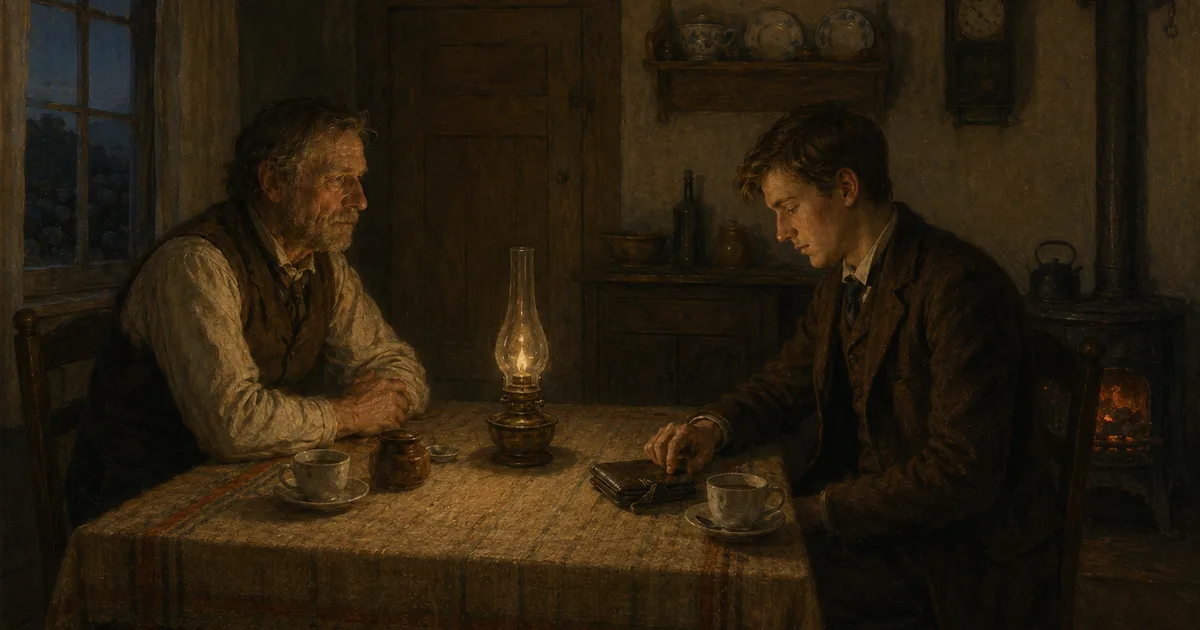
He had thought about the giving since the noon of the Sunday. He had thought about it, in truth, since the spring, when the chest had come and he had known that the boy would come after it, and he had thought about it in the particular way a man thinks about a thing he has decided and has only to find the hour for. The hour was the Tuesday evening. The aunt had gone back across the hill. Peder had gone up to the loft. The supper had been cleared and the lamp was lit at the table and the fire at the stove had gone down to the steady low burn of an August evening that did not need much fire. Olav was at the table at his place. Jens got up from the head of the table and went to the drawer.
The drawer was the drawer beside the accounts ledger, the drawer where Jens kept the things he meant to return to. He had kept, in that drawer, across the years, the letters he meant to answer and the small accounts he meant to settle and the leather roll he had given Olav before the Asta and had taken back the keeping of the rest after Olav had taken the knife out of it. He kept, in that drawer now, a leather purse. He took the purse out and he closed the drawer and he came back to the table and he set the purse at the cloth at the place beside his son’s cup.
The cloth was the autumn cloth his wife had woven in the year 1860, with the small pattern at the corners that she had taken from a cloth her own mother had woven at Rossøy, and the leather purse sat on the cloth at the lamplight.
“That is for Stavanger,” Jens said. “It is what the Dronningen saved you, and what Peder and the aunt and I have put to it.”
Olav looked at the purse on the cloth. He did not pick it up at once.
Jens sat down at the head of the table. He did not say more than he had said, because the more was a thing the boy could weigh for himself, and a father who set a thing on a table and then explained the thing had not trusted the table to hold it. But he had decided, in the days of thinking about the hour, that he would say the one thing about the saving if the boy’s face asked for it, and the boy’s face, looking at the purse, asked for it.
“You sent the twenty crowns of the month home from the Dronningen through Stensøy,” Jens said. “Every month you were at a port that could send it. I did not spend it. I put it in the drawer and I added the months together, and when the Dronningen came home in the spring there was a sum of it. Peder put the price of two of the autumn calves to it. The aunt put a thing of her own to it that she did not say the amount of and that I did not count in front of her. It came to four hundred crowns. It is enough for the year at the navigation school at Stavanger and the room and the keep, if you are careful with it, and you have always been careful with a thing.”
Olav put his hand on the purse.
“Yes,” he said.
He did not say more than the one word, and Jens did not want more than the one word. The word was the word the boy had given him at the boat-shed before the Asta had sailed, when Jens had told him the thing about the Freja and the captains, and the word had been enough then and was enough now. A man who said yes to a thing his father had set on the table had taken the thing and the weight of the thing and the meaning of the saving of the thing, and had taken it without making a speech of the taking, and a speech of the taking would have been worth less than the word. Jens had raised the boy to know that. He had not had to say it to him. The boy had it.
Olav put the purse in the inside pocket of the coat that hung on the chair at the back room that night, with the other things the coat carried, and the four hundred crowns went to the inside pocket of the coat, and the matter of the money was done.
But Jens sat at the kitchen table for a while after Olav had gone to the back room, and he thought about his son.
He had been thinking so since the noon of the Sunday, in the way a father thinks who has had a son at sea for two years and two months and has had the son back at his table for three days. The son was well. The son was a man. The son had come home with three years of the sea on him and a navigation school ahead of him and a young woman at Lindøy who would be his wife when the school was done, and any father who had set those things in a row would have called the row a good row and would have been right to. Jens set the row out. He looked at it. It was a good row.
And there was the other thing.
He did not have a word for the other thing, and he did not look for one, because the looking-for-a-word was a thing a younger man did and Jens was not a younger man. The other thing was a quietness. He had seen it first in the winter of 1876, after the Sigrid, when the boy had come home with a quietness in him that had not been the quietness of a boy who had been away and was glad to be back. He had seen it again, deeper, when the boy had come home from the Asta for the two weeks in the May of 1876. And he saw it now, at the table at Vestbø in the August of 1878, and it was deeper again, and it had stopped being a quietness that a season would lift. It was a thing the boy had brought home from the sea and had not found a place for in the house, and Jens had watched him, across the three days, carry it from the kitchen to the back room and back, the way a man carries a thing in a pocket that the pocket was not cut for.
Jens had sailed thirteen years out of Stavanger. He had come home at the age of thirty-two with a knee and a will not to go out again, and he had not, in the thirteen years, had on his own shoulder the thing he watched his son carry now. But he had sailed with men who had. He had been a young man on the Aase with a man—the man would be sixty now, or dead—who had come off a Gjermund ship in the summer of 1854 thinner than he had gone on, and the thinness had not been the worst of it. The man had come off the ship with a thing in him that the next ship had not taken out and the ship after that had not taken out. Jens had not known, at the time, what the thing was. He had been too young to know that a man could carry a thing the work did not reach. He knew it now. He had lived long enough to know that there were things that went to sea with a man that were not the sea’s, and that did not come off a man at the wharf with his sea-bag, and that a man brought home and set down in a house and lived beside.
He did not know what the thing was that his son had brought home.
He thought, sitting at the table with the lamp going down, that he did not need to know. A father did not always know what had gone to sea with a son. He had not known, when he had carved his own initials into the chest-lid beside his father’s in the year 1843, what would go to sea with him; and his own father had not known; and the not-knowing had not been a failure of fathers. It had been the shape of the thing. A son went out of the house a particular person and came back a person the house had not made, and the part the house had not made was the part the father did not have the reading of. Jens had Bertha’s account of his own wife to set beside this—that the friend who had walked behind her on the path had seen what the husband at her side had not. A man saw a person from the inside-going-out of standing beside them, and there were things only the outside-coming-in could see, and a father stood beside a son the way a husband had stood beside a wife, and there was a reading the standing-beside did not give.
He had not asked Olav what had gone to sea with him. He would not ask. The not-asking was not a failure either. The not-asking was the form the not-knowing took at a father’s table, and it was, he had come to think, the right form—because a son who was asked would have to either say the thing or turn the question, and the saying and the turning were both harder on the son than the not-being-asked, and a father’s table was a place a son should be able to sit at without being made to do the harder thing. Jens had sat his son at the table for three days and had not asked. He would sit him at the table for the rest of the week and would not ask. The boy would go to Lindøy on the Thursday or the Friday and would come back, and would be at Vestbø through the summer, and would cross to Stavanger in the autumn for the school, and in none of it would Jens ask, and the not-asking would be the thing Jens gave his son that was not the four hundred crowns and was not smaller than the four hundred crowns.
The lamp had gone low. The fire at the stove was at the embers. The cloth on the table was the autumn cloth, and the small pattern at the corners was at the edge of the light. Jens put his hand on the cloth for a moment at the worn place where his hand had been at the cloth for eighteen years, and then he took his hand off the table.
He went up to the upper field before he went to bed, the way his father had walked the upper field at the end of a thing, though the August evening was warm and the walk was a short one and he did not go to the far wall. He went only to the place where the home-field ended and the cart-track began, and he stood there in the last of the light with the bay below and the hill above, and he looked down at the roof of the house where his two sons were. The smoke was thin and straight at the chimney. The boy in the back room had four hundred crowns in the coat on the chair and a thing in him that the crowns would not reach and the school would not reach and Olava at Lindøy would, in the years of the marriage, come to stand beside the way Jens stood beside it now—on the outside of it, knowing it was there, not knowing its name, making her own account with it as the friend on the path had made an account with whatever she had seen in his wife.
Jens stood at the upper field until the light had gone from the bay.
Then he went down to the house and banked the fire and went up to his bed.