The American bark came to the wharf at Bordeaux on the morning of the second of July of 1878.
The pilot brought her up the Gironde at the morning tide of the first and the bark anchored at the lower roads at the noon and came up to the wharf at the upper end of the Quai des Chartrons at the morning tide of the second. The petroleum cargo at the hold was unloaded at the wharf through the four days of the second to the fifth.
The crew was paid at the wharf-end office at the afternoon of the fifth.
Captain Hollis sat at the desk at the wharf-end office at the half past two of the afternoon with the ledger at the open part of the run from the eighteenth of April to the fifth of July. He had the wages at the column at the side of each name at the dollars converted to the francs of the Bordeaux bank at the rate of five francs at the dollar at the spring of 1878.
He said the wages at each man as each man came to the desk.
The Englishman came first. The Scot came after. The two Hollanders came after. Sven Haugen came after. The little Swede came at his own time at the half hour later.
Olav came at the four of the afternoon.
The Dane came at the four and the half hour.
Captain Hollis took the wages of Olav and the Dane at his hand at the desk at the four of the afternoon. He held the francs at the desk. He did not set them at Olav’s place at the desk.
He said in the English of a Boston master that the bark was sailing on the morning of the eighth of July from the Quai des Chartrons at the wharf for the run back to Brooklyn in ballast at a four-week passage in the trade. He said the bark was wanting the two able seamen at the foredeck for the run back, at the wages of forty dollars at the month for the petroleum-experience rating, with the half-week ashore at the boardinghouse at the upper end of the Cours du Chapeau-Rouge at full pay through the sixth and the seventh of July.
He said the bark would be at New York at the second week of August.
He said the two able seamen had come on the bark out of the slaveship at the Brooklyn anchorage on the second of April and had been on the bark for the petroleum loading and the eastbound run and the unloading at Bordeaux and the captain had said at the run east at the eighth week that the two of them were the kind of men a master of an American bark of the Boston home-port wanted at the foredeck at every run.
Olav looked at the Dane.
The Dane looked at Olav.
The Dane said in the English of a Danish able seaman at the four of the afternoon at the wharf-end office at the Quai des Chartrons that he was going home.
Olav said in the English of a Norwegian able seaman of three years at sea that he was going home.
Captain Hollis sat at the desk at the wharf-end office for the few seconds after.
He set the francs of Olav at the desk at Olav’s place. He set the francs of the Dane at the desk at the Dane’s place. He took the pen and wrote at the column at the side of Olav’s name at the ledger: Olav Hestby of Norway—able seaman, special notation for ability and good deportment, discharged Bordeaux 5 July 1878. He wrote at the column at the side of the Dane’s name the same notation. He blotted the ink at the small blotter at the side of the ledger.
He held the ledger out at the desk to Olav.
Olav signed the line.
The Dane signed at the line below.
Captain Hollis said: that will do.
He stood up at the desk. He held the hand out to Olav. Olav took the hand. The hand was the hand of a Boston master who had paid the wages of an American bark across the three months from the eighteenth of April to the fifth of July at the brotherhood-bark of the new regime. The hand was warm at Olav’s hand.
The captain took the Dane’s hand at the second.
He said good evening to the two of them.
He went out of the wharf-end office to the bark at the wharf.
Olav and the Dane stood at the desk at the wharf-end office at the half past four of the afternoon with the francs at the desk at each man’s place.
Olav counted the francs.
Four hundred and fifty francs of the Bordeaux bank at the rate of five francs at the dollar at the spring of 1878. Ninety dollars at the run from the eighteenth of April to the fifth of July at the wages of thirty-five dollars at the month at an able seaman of the brotherhood-bark.
The Dane counted his.
Four hundred and fifty francs at his place.
The two of them put the francs at the inside-pocket of the coat each.
They went out of the wharf-end office.
The boardinghouse Halvor the Stavanger steward had used at the Bordeaux trade was at the upper end of the Cours du Chapeau-Rouge at the second street of the second block above the river.
It was a boardinghouse of two floors with a parlor at the lower floor and rooms at the upper floor at the rate of five francs at the day at the room for two men with the food at the table at the noon and the supper at the evening included at the rate.
Olav and the Dane took a room at the upper floor at the front side at the evening of the fifth of July.
The room had two narrow beds at the side walls and a wash-stand at the corner and a small chest of drawers at the lower wall. The window at the upper end looked out at the Cours du Chapeau-Rouge at the lamps of the evening at the Bordeaux summer. The room cost five francs at the day for the two of them, with the food.
They ate the dinner at the noon and the supper at the evening of the fifth.
They slept at the room the night of the fifth.
They went to the tailor’s shop at the morning of the sixth.
The tailor’s shop was at the lower end of the Cours du Chapeau-Rouge at the second block above the river at the corner of the Rue Sainte-Catherine.
It was a shop of two floors with the tailor’s-room at the upper floor and the racks of suits and the counter of fabrics at the lower floor. The tailor was a Bordeaux tailor of about fifty in a dark wool coat with the measuring-tape at the collar at the side of the neck. The tailor’s assistant was a young man of about twenty in a white shirt with the small notebook at his hand.
Olav came in at the door at the half past nine of the morning.
The Dane came in at Olav’s side.
The tailor looked at the two of them. He looked at the wool of Olav’s coat and at the wool of the Dane’s coat and at the boots of Olav and the boots of the Dane and at the inside-pocket of Olav’s coat where the francs were and at the inside-pocket of the Dane’s coat where the francs were. He said good morning in the French of a Bordeaux tailor. He said the shop had the suits of a Bordeaux tailor for the gentlemen at the racks at the lower floor and the cut at the upper floor for the gentlemen who wanted a cut to the order.
Olav said in the French he had learned at the four hours of the previous evening from the Stavanger carpenter who had been at the Bordeaux trade fifteen years before and who had taught him the words for suit, coat, trousers, waistcoat, hat, umbrella, and good day—Olav said in this French that he wanted a suit at the racks.
The Dane said in the Danish-French of a Danish able seaman at the wharves of the European ports for the years he had been at the wharves the same.
The tailor took them at the racks at the lower floor.
The racks held the suits of a Bordeaux tailor at the racks at the morning of the sixth of July of 1878. The suits were of wool and of linen and of a worsted-wool-and-linen mix and of a fine cloth of a kind that was not at the wool of a sailor’s coat. The colors were of the brown and the dark gray and the black and the dark blue and the green of a Bordeaux summer. The cuts were the cuts of a Bordeaux tailor of about fifty in the year of 1878.
Olav looked at the racks.
He looked at the brown wool suit at the upper end. He looked at the dark gray suit at the side. He looked at the black at the lower end and at the dark blue beside the black.
He laid his hand at the dark gray wool suit at the side.
He took it off the rack. He held it at his hand at the upper end. He looked at the cut. The cut was the cut of a Bordeaux tailor at the dark gray wool of the year of 1878. The wool was a wool of the kind that would last twenty years at the closet at Vestbø at the back room. The cut was the cut of a man.
He set it back at the rack.
He took the brown wool suit. He looked at it. He held it at his shoulders at the small mirror at the wall. The brown was the brown of a Bordeaux summer at the wool of a Bordeaux tailor at the year of 1878. The brown was a brown that would not look out of place at the kitchen at Vestbø.
He put the brown at his arm.
The Dane took the black at the lower end of the rack.
He held the black at his shoulders at the mirror at the wall. The black was a black of the kind a man wore at a Sunday and not at a weekday. The Dane held the black for the time it took a Danish able seaman at a tailor’s shop at Bordeaux to hold a black wool suit at his shoulders at the mirror at the wall. He set the black back at the rack.
He took the dark blue.
The dark blue was a dark blue of the kind a man wore at every day at the wharves of the year of 1878. The Dane held the dark blue at his shoulders. He put the dark blue at his arm.
Olav looked at the waistcoats at the counter.
The counter held the waistcoats of a Bordeaux tailor at the second drawer of the cabinet at the side of the racks. The waistcoats were of the wool of the suits and of a fine silk-and-wool-mix that was not at the wool of the suits and of a velvet that was not at the wool or the silk.
Olav held the wool waistcoat at his hand. The wool waistcoat was a brown wool waistcoat at the brown of the suit. He set it at the arm with the suit.
He held the silk-and-wool waistcoat at his hand. The silk-and-wool was a fine cloth of the kind a Bordeaux man of forty wore at the year of 1878 at the dark gray-and-mauve check of a kind that was not at any cloth that had been at the kitchen at Vestbø or at the parlor at Lindøy or at the boardinghouse at Bredalmendingen at the four hours Olav had been there in July of 1876.
He held the silk-and-wool waistcoat at his hand at the counter for some seconds.
He set it back at the drawer.
The Dane held the wool waistcoat at the dark blue at his hand. He set it at the arm with the suit. He did not hold the silk-and-wool at the drawer.
The tailor took the two suits and the two waistcoats and the hats at the rack at the lower end and the umbrellas at the stand at the door and totaled the cost at the desk at the half past ten.
The cost was at the eighty francs at each of them at the suit and at the twelve francs at the waistcoat and at the eight francs at the hat and at the five francs at the umbrella. The total was at the hundred and five francs at each of them.
Olav paid the hundred and five francs at the inside-pocket of the coat.
The Dane paid the hundred and five francs at the inside-pocket of his coat.
They went up to the tailor’s-room at the upper floor with the tailor’s assistant for the fittings of the cuffs and the hems.
The fittings were at the half hour.
They came down at the eleven of the morning with the suits at the brown paper at the assistant’s hand and the hats at the brown paper at his other hand and the umbrellas at his shoulder.
They walked back to the boardinghouse with the brown-paper packages and the umbrellas.
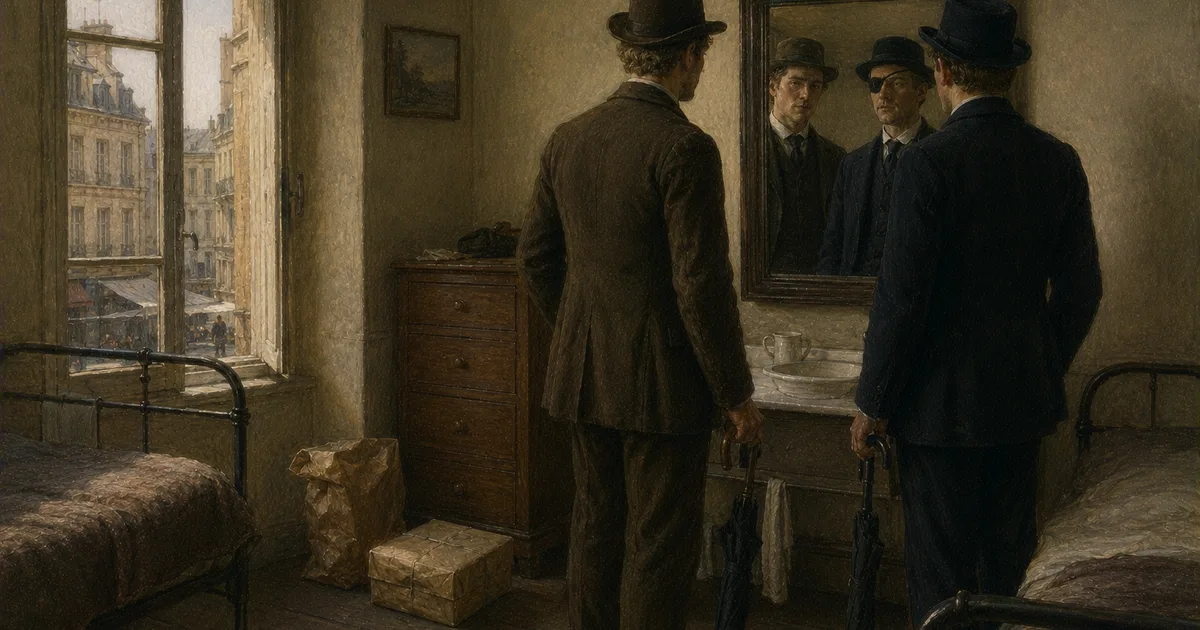
They put on the suits at the upper room at the boardinghouse at the noon.
Olav looked at the mirror at the wash-stand at the corner.
The man at the mirror was a man of twenty-one in the brown wool suit of a Bordeaux tailor of the year of 1878 with the brown wool waistcoat at the chest and the brown hat at the head and the umbrella-as-cane at the hand. The man at the mirror was not Olav Hestby of Vestbø at Finnøy at the kitchen at Vestbø. The man at the mirror was a Norwegian sailor of three years at sea who had been discharged with the special notation for ability and good deportment at the wharf-end office at Bordeaux on the afternoon of the fifth of July of 1878 and was now in the brown suit of a Bordeaux tailor at the room at the boardinghouse at the upper end of the Cours du Chapeau-Rouge.
The Dane looked at the mirror at his side.
The Dane was in the dark blue wool suit of a Bordeaux tailor with the dark blue wool waistcoat at the chest and the dark blue hat at the head and the umbrella-as-cane at the hand. The dark blue suit at the Dane’s shoulders was a suit a Bordeaux tailor had cut for a Danish able seaman at the morning of the sixth of July of 1878 at the lower floor of the shop at the corner of the Rue Sainte-Catherine.
The two of them stood at the mirror at the wash-stand at the corner of the upper room at the boardinghouse at the upper end of the Cours du Chapeau-Rouge at the noon of the sixth of July of 1878.
The Dane said in Danish at the mirror: to dudes.
Olav said in Norwegian: yes.
The two of them stood at the mirror for some seconds more.
He did not name to himself, at the mirror at the boardinghouse at the upper end of the Cours du Chapeau-Rouge, what the man at the mirror was.
Then they went out of the room and down the stairs and out of the boardinghouse to the Cours du Chapeau-Rouge at the noon for the dinner at the upper end of the street.
Sven Haugen had been paid off at the wharf-end office at the four of the afternoon of the fifth of July at the wages of the eleven-week run east. He took the leather case to the post-office at the Bordeaux quay at the morning of the sixth and mailed the eleven weeks of letters to Hanne at Sandviken. He signed at the articles of a Bordeaux-Bergen packet at the afternoon of the seventh of July.
The Sandefjord ship was at the wharf at the lower end of the Quai des Chartrons at the morning of the eighth of July.
The Sandefjord ship was a Norwegian bark of about four hundred tons in ballast for Norway. The captain was a man of about sixty in a wool coat of a Sandefjord cut with a full black beard at the chin and a captain’s cap at the head. He was at the wharf-end office at the morning of the seventh of July for the new crew.
Olav and the Dane came to the office at the half past nine.
They signed the articles at thirty dollars at the month at the run from Bordeaux to Sandefjord at the cargo of ballast. The captain was a jovial man of about sixty who said good morning at Norwegian and good morning at Danish and good morning at Swedish and asked the two of them whether they had been at the bars of an American bark out of Brooklyn for three months. Olav said yes. The Dane said yes. The captain said the Sandefjord ship would sail at the morning tide of the ninth.
The Sandefjord ship sailed at the morning tide of the ninth.
She went out under tow down the Gironde at the morning of the ninth and came to the lower roads at the noon and dropped the tow at the noon and set the topsails at the wind from the south-west at four knots at the lower roads. The bark went out at the lower roads at the early afternoon for the bar of the Gironde mouth.
The American bark was at the lower roads of the Gironde at the early afternoon.
Olav saw her at the larboard side of the Sandefjord ship at the four bells of the afternoon watch. She was at the topsails and the topgallants at the wind from the south-west at four knots. She was at the run for the bar of the Gironde mouth and the open sea beyond the bar for the run back to Brooklyn in ballast at the four-week passage.
She came up at the lee of the Sandefjord ship at the half past two of the afternoon.
Captain Hollis was at the upper end of the deck-house of the American bark at the half past two. He held the speaking-trumpet at his hand at the upper end of the deck-house. He stood at the rail at the larboard side of the deck-house and looked at the Sandefjord ship at the lee.
He raised the speaking-trumpet at his mouth.
He said good voyage across the lee at the four bells and the half hour of the afternoon watch at the Sandefjord ship.
Olav and the Dane were at the foredeck of the Sandefjord ship.
They lifted their hands at the foredeck.
Captain Hollis turned at the upper end of the deck-house.
He said something at the Finnish first mate at the deck. The Finnish first mate said something at the Scot at the wheel. The Scot brought the bark up at the wheel.
The American bark dipped the national colors at the ensign-staff at the stern at the half past two and the few seconds of the afternoon watch of the ninth of July of 1878 at the lower roads of the Gironde.
The colors went down at the staff and came up at the staff at the few seconds.
The American bark dipped the colors a second time.
The colors went down and came up at the few seconds.
The American bark dipped the colors a third time.
The colors went down and came up at the few seconds.
Olav stood at the foredeck of the Sandefjord ship at the larboard side.
The Dane stood at the foredeck at Olav’s side.
The Sandefjord captain at the upper end of his own deck-house at the wheel-box did not say anything at the dipping.
The American bark turned at the wheel at the second dip and came up at the wind for the bar of the Gironde mouth. The Sandefjord ship held at the north for the Bay of Biscay.
The two barks went out at the lower roads in their different directions.
Olav looked at the American bark for the half hour after the dipping at the larboard side of the Sandefjord ship as the American bark went west and the Sandefjord ship went north.
The Dane looked at the American bark at the larboard side.
Neither of them spoke at the foredeck.
The wind held at the south-west at four knots at the late afternoon of the ninth of July of 1878 at the lower roads of the Gironde at the bar at the open Atlantic beyond.
The American bark went west.
The Sandefjord ship went north.