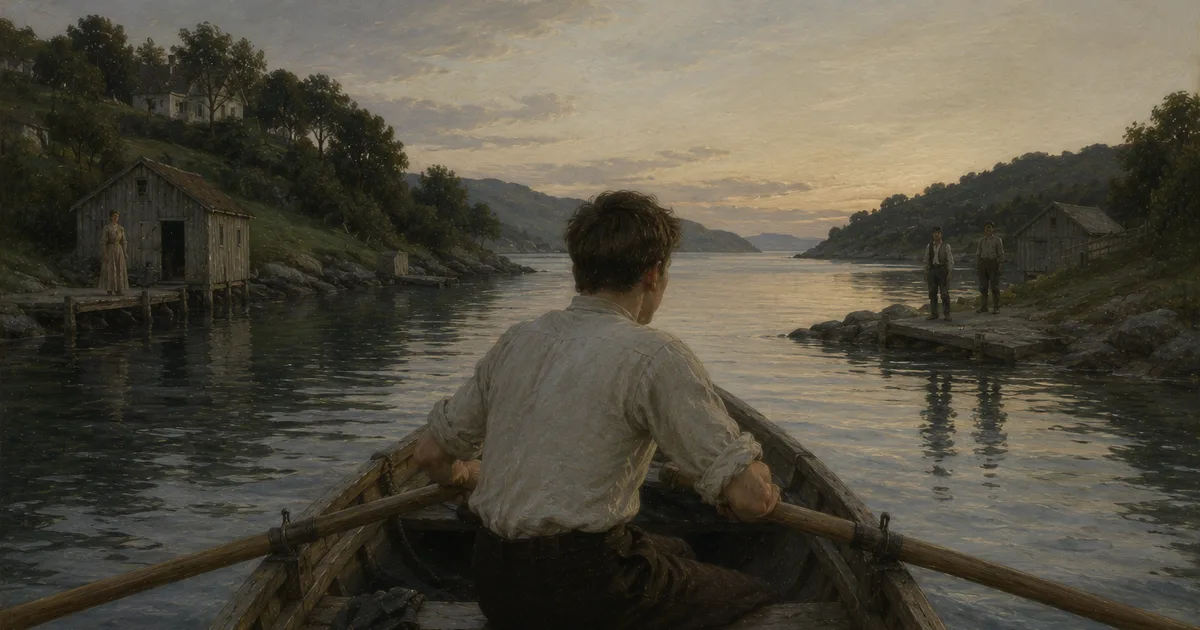
Olav crossed from Vestbø to Lindøy in his father’s boat.
The boat was the small boat at the Vestbø landing, the boat Olav had caulked at the boat-shed at the two weeks before the Asta in the March of 1876, and it had been at the landing through the two years and one month Olav had been at sea, and it was at the landing now at the August of 1878 for the crossing to Lindøy. Olav took it out at the morning of the Thursday of the eighth of August at the tide-state that gave him the run of the strait, and he rowed it across to the Lindøy boathouse, and he came back to Vestbø in the evening, and the crossing was a thing the summer settled into at the days after.
The strait between Finnøy and Lindøy was a strait of an hour at the oars at a tide that did not set against the boat and a longer time at a tide that did. Olav had rowed the strait once, two years and one month before, at the steamer; he had not rowed it at the oars of a small boat before the August of 1878. He rowed it now. The body of a man who had been at the bars of the Kvik and the American bark and the Sandefjord ship and had laid the figure-eight at the cat-falls of every ship he had been on since the Asta was a body that rowed a small boat across a strait at the rate the strait gave it. The water at the strait was the water of the Stavanger fjord at the summer. The slopes at the two sides were at the green of the late summer. Olav rowed the boat across, and the rowing was a work the body did not have to be told, and the body did it.
The summer at Lindøy was the summer Olav had been writing at since the eighteenth of July of 1876.
He had not known, at the writing, what it would be. A man wrote the summer at Lindøy at a letter at a watch-bunk at the Atlantic and the words were words, and the summer when it came was not words. The summer when it came was Olava at the door of the kitchen at the half past nine of the morning. It was the upper slopes of Lindøy at the green of August where Olava walked with him at the afternoons the household work was done. It was the small boat at the strait between Lindøy and Sandøy where Olava took the oars at the half of the crossing because she had rowed the strait since she was a girl and the rowing was a thing her body did not have to be told either. It was the household at the supper at the evenings, Bjørn at the head and Bertha at the stove and Olava at the side of Olav at the place that had been set for him at the east side at the week of the homecoming and was the place set for him at the summer.
It was the garden.
Bertha kept a garden at the south side of the house at Lindøy where the slope held the sun. It was a garden of the herbs and the small vegetables and a border of the flowers a Norwegian-coast wife of the year 1878 kept for the keeping of them. Olava went to the garden at the afternoons for the herbs for the supper. Olav went with her to the garden at one afternoon of the second week of August and stood at the edge of the garden at the low stone border while Olava was at the herbs.
Olava bent at the row of the herbs. She put her hand at the rosemary and broke a stem of it and set the stem at the small basket at her arm. She put her hand at the chives. She put her hand at the parsley at the lower end of the row.
Olav stood at the edge of the garden and watched her hand at the herbs.
The hand of Olava at the herbs at the garden at the south side of the house at Lindøy at the afternoon of the second week of August of 1878 was a hand Olav had been at the watching of for the half of an hour and had not said anything at the watching of. It was the hand that had been at the cuff of the glove at the pew rail at the chapel at Rossøy. It was the hand that had set the bowl at his place at the kitchen at the week of the homecoming. It was a hand Olav was at the summer of and would be at the marriage of, and the body of him at the edge of the garden registered the hand at the herbs as a thing the body was glad of, and Olav stood at the low stone border and was glad.
Olava stood up from the row with the basket at her arm.
She looked at Olav at the edge of the garden.
She did not ask what he had been at the watching of. She had a way of not-asking that Olav had come to know at the week of the homecoming and at the summer—a not-asking that was not the same as a not-noticing, but was a thing she did with a thing she had noticed and had decided to leave where it was. She had asked him a question at a ravine at the June of 1876 and had heard the answer, and she had not asked him a question since that he had not been able to answer, and Olav had come to understand at the summer that the not-asking was a thing Olava did the way her mother did it, and that it was a kind of care, and that it was the kind of care he would be married to.
“The supper will want the herbs,” she said.
“Yes,” Olav said.
They went up to the house with the basket.
The Sunday of the eighteenth of August was at the church at Hesby.
Olav crossed from Lindøy to Vestbø on the Saturday evening and walked to Hesby with his father and Peder on the Sunday morning, in the order they had walked it since he had been a boy—Jens in front, Peder half a step behind Jens, Olav half a step behind Peder. The road to Hesby was dry at the August. The fields above the road had been mown in the first part of the month and the second crop was coming up at the green of a grass that knew it would not be cut again. They went into the church and sat at the Hestby pew at the third row from the front at the side of the aisle.
Rev. Lindbergen was at the pulpit in the black coat. The spectacles had slipped the small distance down his nose. His text was not the January text of the great wind from the wilderness, and was not the Easter text. His text was from the sixty-fifth psalm, and it was the verse of the crowning of the year with the goodness, and he preached on it in the slow careful voice at the August Sunday with the church windows letting in the light of the late summer. Olav sat between Peder and his father. He sang the hymns he had known since his confirmation under Lindbergen in the spring of 1872.
It was at the churchyard after the service that Olav saw Karsten Tjørn.
The parish came out of the church at the door and stood at the churchyard at the few minutes a parish stood at a churchyard at a Sunday before the families went to their roads. Olav stood with his father and Peder at the side of the path. Karsten Tjørn was at the upper end of the churchyard with his mother at his arm. Karsten was a man of twenty-six now. He had a dark coat. His hair was cut at the length a Finnøy farmer of twenty-six wore it at the summer, which was not the length it had been over the collar at the pew at the January of 1876.
Olav had not seen Karsten Tjørn in two years and one month.
The two of them saw each other across the churchyard.
Olav looked at Karsten. Karsten looked at Olav. The look held the few seconds a look held at a churchyard between two men who had been at a parish-school as boys and had not seen each other in two years and one month. Then Karsten gave Olav a small nod—a nod of the head, the length of an inch, the kind of nod a man gave another man at a churchyard. And Olav gave the nod back.
The nod was a small thing.
It was a thing that a man at the churchyard at the side of the path, looking at the two men, would have seen as the nod of one parish-acquaintance to another at a Sunday—and would have been right to see it as that, because that was the most of what the nod was. Karsten’s mother did not see the nod. She was at the talking to a woman of the parish about a thing at the Hesby road. Peder did not see it. Jens did not see it.
Olav did not name to himself, at the churchyard at Hesby at the Sunday of the eighteenth of August of 1878, what the nod had been at the body of him beyond the parish-nod it had been at the eye of the churchyard.
He had the language now for a thing he had not had the language for at the pew at the January of 1876, when he had been a boy of eighteen who had lost his place at the hymnal at the winter light at the back of Karsten Tjørn’s neck and had not known he had lost it. The language had come to him at the long oak table at the Bristol Bethel reading-room and at the bench at the Hamburg captain’s office and at the rail at Esbjerg, and the language was in the body of him at the churchyard at Hesby, and the nod between him and Karsten was a thing the language let him know the size of. He knew the size of it. It was the size of a nod. It had not advanced at the eight feet of churchyard air between him and Karsten and it had not died at the two years and one month, and Olav let it be the size it was, and Karsten’s mother took Karsten’s arm, and the Tjørns went to their road.
Olav walked home to Vestbø with his father and Peder in the order they had come.
He did not think, on the road, about the nod. He thought about the road, which was the Hesby road in the August with the second crop coming up in the fields and the ditches dry. He would think about the nod later, the way he had thought later about a long look at a churchyard gate in the March of 1876, and the thinking-later would be a small thing too, because the nod did not ask to be thought about at length. It asked to be let be the size it was.
The summer went on at the rowing between Vestbø and Lindøy.
Olav rowed the strait at the mornings and the evenings of the days the household work and the Vestbø work let him. He was at Vestbø for the work his father and Peder had at the upper field at the second haying and at the byre. He was at Lindøy for the days Bjørn had no work that wanted a third pair of hands, and the days at Lindøy were the days at Olava. The summer was a summer of the two islands and the strait between them, and the boat at the strait, and the long light of a Norwegian-coast August that held until the eleven and then went to the blue that was not dark.
It was at an evening at the end of August, rowing back from Lindøy to Vestbø, that Olav had the thought.
He was at the oars at the middle of the strait. The light at the strait was the long light of an August evening going to the blue. The slopes of Lindøy were astern of the boat at the green going to gray. The slopes of Finnøy were ahead of the boat. Olava was at the Lindøy boathouse behind him, and his father and Peder were at the Vestbø landing ahead of him, and the four hundred crowns were at the inside pocket of the coat at the chest at the foot of the bed at the back room, and the school at Stavanger was at the autumn ahead. Olav rowed the boat at the strait at the evening, and the body of him at the oars at the middle of the strait at the end of August of 1878 was at a thing the body had not been at before, which was the thing of being at a day that the days after would be measured against.
He did not say the thing to himself in those words.
He had the thought at the oars at the middle of the strait, and the thought was that the summer at the two islands and the strait was a thing he would be at the remembering of, and that the remembering would be a remembering of a kind a man did not have many of, and the body of him rowed the boat across the rest of the strait at the long light.
The summer ended at the way a summer ended, which was at the light going shorter at the evenings and the second crop going to the haying and the air at the mornings carrying the first of the autumn.
At the third week of September Olav was at Vestbø at the evening at the kitchen table. The supper had been cleared. Jens was at the head of the table. Peder was at the loft. Olava was at Lindøy across the strait. The leather purse with the four hundred crowns was at the inside pocket of the coat, and the coat was at the chair at the back room, and the chest was at the foot of the bed.
Jens set down the cup at the saucer.
“The school takes the students at the first week of October,” Jens said. “You will want to be at Stavanger before the first week. You will want a few days at the room before the school.”
“Yes,” Olav said.
“You will go to Stavanger.”
“Yes.”
Jens did not say more than that. He had said, at the Tuesday of the August at the giving of the purse, the thing about the school and the four hundred crowns and being careful with a thing, and he did not say it again at the third week of September, because a thing said once at a kitchen table did not want a second saying. He had said you will go to Stavanger the way a man said a thing that had been decided since the spring and was only now at the hour of it.
Olav sat at the table at his place at the third week of September of 1878 and the summer was behind him.
He had been at the two islands and the strait for the summer. He had been at the rowing and the garden and the upper slopes and the Sunday at Hesby and the suppers at the two households. He had been at Olava at the summer in the way a man was at the woman he would marry in the year the school was done. The summer had been the summer, and it was behind him now, and the work he had come home from the sea to do was at Stavanger at the first week of October.
He went to the back room.
The coat was at the chair at the foot of the bed. The chest was at the foot of the bed at the place his father and Peder had set it in the May. Olav did not open the chest. He stood at the small window of the back room for the few minutes at the September evening, and the light at the window was the light of a September evening at the latitude of Finnøy, going shorter than the August light had gone, and Olav stood at the window and was at the end of the summer.